Topics

Showing posts with label Non-Sports Post. Show all posts

Thursday, May 16, 2013

Non-Sports Post: Dr. J on Memphis and the Grizzlies

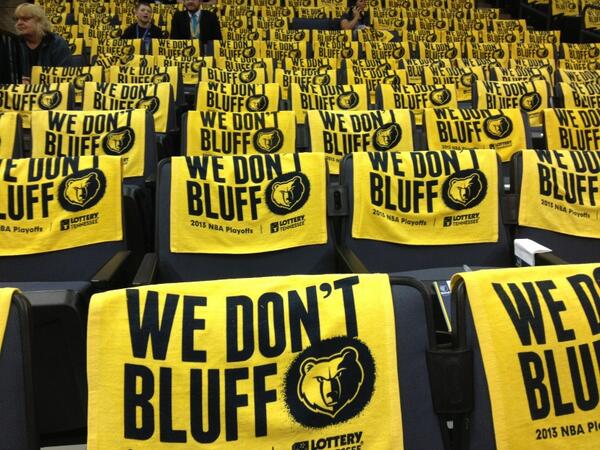
Like many other people in this town, I had to smile last night as I watched the Memphis Grizzlies advance to the NBA's Western Conference Finals for the first time in franchise history. It took a long time for the Grizz to get where they are now, and almost anybody you pass on the street would tell you exactly how hard-earned an achievement it was.

One of those people is Dr. Leigh Johnson, a native Memphian and professor of
philosophy at Rhodes College, a small liberal arts school of about 2,000 students located just a few miles east of downtown proper.  As a recent graduate, I am a bit sad to admit that I never had the pleasure of taking one of her classes, but I know a little bit about Dr. J through her writing. She maintains a blog through which she expounds on a wide range of topics, and last night, she took the time to appreciate the Grizzlies' role as a key cog in the resurgence and emotional renaissance in this much maligned city. I've excerpted her post here, but I encourage anyone trying to understand what the Grizzlies' success means to its fans to read it in full (link below).

From Dr. J:
Memphis could always have done a lot of things easier than we did.  But we've always elected, voluntarily or otherwise, to do it nice and rough.  Why?  Quite simply, because if you go down to the [Mississippi] river, you're gonna find some people who live.  And real living, for the vast majority of us, is hardly ever nice and easy.  There are precious few places in this country where people so deeply and existentially understand that just living is rough-- just getting up every day hoping that it's better than the last, just finding some place to work and to make ends meet, just manufacturing the means to suffer or combat a million both tragic and mundane injustices, just finding a warm (or cool) and safe place to lay your head at night, and just finding some people to eat and laugh and love and dance with while you try to do your best at living.  It's something that requires all the heart, grit and grind a person can muster.
Heart, grit and grind don't pay the bills, though, and I'll be the first of the million Memphians to testify to that. [Tina Turner's] "Proud Mary" says that you don't have to worry 'cause you got no money, people on the river are happy to give. But, truth is, Memphis is poor and not a lot of people have a lot to give.  Memphis has very real and abiding problems with violence and crime.  Memphis is and has always been deeply divided, a microcosm of the very same race and class issues that deeply divide our country as a whole.  Memphis fights with itself, which means that it loses every battle it wins, and wins every battle it loses.  
My dear friend…once told me that "you can't really say that you love a city until it's given you reason not to."  Of course, I know of all the reasons that people say that Memphis is unlovable. And they have no idea the love they're missing out on by not believing in this underdog."  
I've always been an unapologetic fan of the underdog… [and] I'm a self-appointed ambassador for Memphis. Locals will tell you, sometimes with gratitude and sometimes with exasperation, that Memphis is a place that won't let you go, keeps bringing you back, whether you want it to or not.  
Given the right conditions, which have only just arrived, Memphis has more to give than anyone ever imagined. And I'm even less surprised that, as we say here, ERRYBODY is jumping on board.
Welcome aboard the Memphis bandwagon, y'all.  The most soulful, passionate, crazy, infectious, tasty, libidinous, musical, gritty and, to be honest, sexiest wagon around.
Full post here: http://readmorewritemorethinkmorebemore.blogspot.com/2013/05/i-bet-you-gonna-find-some-people-who.html

I recognize that the Grizzlies are just a sports team, and if they were not a good team, as they were for a long time, their existence wouldn't mean much to Memphis. That said, their success is a beacon for all of the people in this town, and Dr. J does well to get at that feeling, one that's so palpable this week.

Thursday, February 28, 2013

Memphis Grizzlies’ owners: “We have a greater opportunity than ever before”

If you’re looking for a snapshot of what the Memphis Grizzlies’ future holds, just ask minority-share owner Duncan Williams. He’ll paint you a picture. 

“We’re going into [the Grizzlies’] 12th year [in Memphis], and I have a nine-year-old son and 10-year-old daughter,” Williams said on Tuesday. “And I can tell you, they don’t buy any jerseys except Grizzlies jerseys.” 

Williams’ anecdote highlights the two-fold impact of Memphis’ only professional sports team in a light-hearted but enlightening way. Since moving east from Vancouver in 2001, the Grizzlies organization has woven itself into the fabric of the Bluff City in a way that outshines traditional standbys like Ole Miss and Tennessee football, and even, in some ways, Memphis Tigers basketball.

“Being a sports fan and a longtime Memphian, I can’t think of any better thing to be involved in,” minority-share owner Edward Dobbs said.

On the court, the franchise has risen from the dregs of the NBA barrel to earn playoff appearances in each of the previous two seasons. Off the court, the organization and its charitable foundation were recognized internationally by Beyond Sport as “Sport Team of the Year” for 2012, a testament to the depth of the team’s commitment to serving its community.


Earning the honor of 'Sport Team of the Year' is not easily done—it took a lot of hard work, and at least one of the Grizzlies new minority-share owners recognized that much of that effort had already been put in before they came on the scene last November.

“We were very fortunate, in coming in as a new ownership group, that we had a team that had a real identity,” Jason Levien said. In addition to having a stake in the team, Levien is also the Grizzlies’ CEO.

“They called it ‘grit and grind’: it’s about winning, selflessness, putting the team first… Our motivation is about winning, about sustained success, about having the kind of players that make this community proud, having the kind of team that makes this community proud, and doing things on and off the court which reflect positively on Memphis. We think we’re headed in that direction, and we feel very excited about it.”

Williams, Dobbs, Levien and former Grizzlies guard Elliot Perry spoke to a lunchtime crowd of a few hundred on Tuesday at the Holiday Inn on Poplar Avenue. The New Memphis Institute, as part of their “Celebrate What’s Right” lecture series, sponsored the luncheon panel of minority-share owners. Grizzlies Charitable Foundation director Jenny Koltnow moderated the discussion, and AutoZone founder Pitt Hyde, another Grizzlies stake-holder, provided the opening remarks.

“We have a greater opportunity than ever before,” Hyde said of the team’s ability to have success and affect change in the city. “It is important to all of us to make sure every seat is filled—it’s important for our image, it’s important to the team to show your support. As business people or people involved in any part of our city, you can always buy tickets, whether you’re a basketball fan or not. Give them to customers, give them to friends, go yourself—I think you’ll find that it’s easy to get addicted to the Grizzlies.”

As Perry pointed out, the addiction is sometimes a two-way street for Grizzlies players.

“What is a little bit unusual about this team is, I played on many teams in the NBA, and the players [on those teams] were not this engaged in the community,” the former University of Memphis star said. “You would have one, maybe two players who realized how to use that platform, but we can go down the list of seven, eight, nine guys who are really engaged in this community.”

That community, by the way, is growing. Levien noted that the team has recently expanded its broadcast radius into Nashville and Little Rock in order to solidify the Grizzlies’ presence as “the team of the Mid-South.” Additionally, the gameday experience at FedExForum is also being improved in a variety of ways to make sure ticket sales can be maintained and (hopefully) increased.

“One thing we really want to do is create a more exciting [game] experience,” Levien said. “Folks come to the game for two-and-a-half hours, and we want to have a better dining experience [for them]. We spend a lot of hours talking about that – what food options there are, what kind of entertainment there is for kids and families that are coming to games. We’re spending time looking at all those things to improve the quality so that we can be an even bigger and better asset for the community.”

As far as progress on the court, Levien and Perry both feel that the Grizzlies have improved their stock through recent trades.

“We feel as though, with the moves we made in the past month, we’ve added substance here,” Levien said. “We got a player in Tayshaun Prince who won an NBA championship [with the Detroit Pistons in 2004]. We got a young player we’re very excited about, Ed Davis, who is a terrific guy to watch because he’s such a great athlete, a young guy who we think is on the way up in his career. He won an NCAA championship at the University of North Carolina [in 2009]. We got a very strong outside shooter, a guy who I think has a lot upside as well, in Austin Daye.”

“I’m very optimistic about the team,” Perry said. “It’s always hard when you trade a guy like Rudy Gay, given that he was such an instrumental part of the team. I think the sky is the limit for him and he really will flourish in Toronto, but ultimately I know that if anything happens here, we have a good enough team [to withstand that adversity].”

Asked about the long-term methods for keeping the team competitive, Levien emphasized the use of advanced statistics to evaluate the team, seizing on a trend which has quickly infiltrated the NBA after being incubated in Major League Baseball over the last two decades. Recently-hired vice president of basketball operations of John Hollinger is someone Levien considers “a founding father of basketball analytics” because of Hollinger's innovative work on hoops statistics while at ESPN, and his presence in the front office, along with new director of player personnel and basketball development Stu Lash, should be a boon to general manager Chris Wallace. Levien also mentioned the creation of a decision-making system which will help guard against the kind of ill-advised, panic-stricken transactions that are too often made right on the heels of a bad loss, a devastating player injury or an ugly statistical report.

Dobbs, one of the latest additions to the minority-share ownership group, said that his initial meeting with Levien was all he needed to hear to be sure the team was on the right track.

“When I first met with Jason, I was really struck by his vision of what the team was going to be, not only from the standpoint of wins and losses, but what the team was going to be in the community and to the fans and people coming to games,” Dobbs said. “When you put all of those things together, it was almost like I couldn’t say no [to having an ownership stake].”

“I’m thrilled to be part of it. It really is a dream come true.”


What are your thoughts on the Grizzlies' prospects this season and in coming years? In what ways have you seen them benefit the Memphis community? Feel free to comment below.
--

[Photo caption: Edward Dobbs, center, a minority-share owner in the Grizzlies, talks about his involvement in the team as part of the New Memphis Institute's "Celebrate What's Right" luncheon at the Holiday Inn on Poplar Avenue.]

Wednesday, February 20, 2013

“Meet the Press” panel wrap: Memphis media figures encourage next generation


If at any point in the last few years you have asked the question “What good is journalism anymore?’, you ought to know that you are not alone. In fact, it is a question that journalists themselves ponder a lot, and they have strong answers to support their ideas.

L-R: Jason Smith, Richard Thompson, Michelle Diament, Brooke
Thomas, Louis Goggans, Wendi C. Thomas.
On Tuesday afternoon, a number of prominent Memphis journalists convened in the Benjamin L. Hooks Central Library for a “Meet the Press” session with high school and college journalism students. The event helped kick off the Scholastic Journalism Week initiative of the Journalism Education Association, a non-profit organization that supports journalism teachers and advisers nationwide.

“Scholastic Journalism Week is a time to recognize journalism at high school and college levels,” panel moderator Otis Sanford said. “I worked at daily newspapers [including The Commercial Appeal] for 35 and a half years, and I still believe that there is plenty of passion in journalism.”

The panel of six journalists represented a variety of ages and positions, from veteran Commercial Appeal columnist Wendi C. Thomas to youthful FOX13-TV news anchor Brooke Thomas (no relation). There was even a reporter who reports on the industry of journalism itself, Mediaverse’s Richard Thompson.  Each of the six panelists found their own way into their field.

Jason Smith, a Commercial Appeal reporter who covers the University of Memphis men’s basketball team, spoke candidly about how he once lost his college scholarship after one semester and spent five years figuring out what to do next.

“You talk about somebody whose life was going nowhere—I was a security guard, I tried construction with my brother… It was about 1999, and I just said, ‘You know what, I don’t like this.’ So I am here as evidence that at any time in your life, you can drop what you are doing. If you want to go in another direction, you can do it.”

Smith, whose father still works as a reporter for FOX13-TV, scratched his own television itch through classes at the U of M before having a professor,  convince him to try the print side of journalism.

“I never thought I was, but he said ‘You’re a decent writer. You know, with newspapers, you get a little bit more of an opportunity to dive into stories. You get a little more time,’” Smith recalled. “And…I believed him. You had inches and inches and inches of newsprint to tell a story, and I thought you could delve into it more.”

For Memphis Flyer reporter Louis Goggans, the journey started much earlier.

“When I was in elementary school, my father purchased for me a 12-month subscription to Vibe, a music and entertainment magazine,” Goggans explained. “I am a big rap music fan…I just read the articles—the way they were so vivid and detailed made me feel like I was right there when they were interviewing the artists. From there, I just developed an interest in print journalism, started reading other magazines, and started writing.”

 “I don’t have a particular beat [with the Flyer], so I write about a wide variety of things, which is kind of my goal,” Goggans said. “I like to branch out and reach a large age range and people of different races, and [my position] provides me the ability to do that.”

Brooke Thomas, the television anchor, said that in spite of her tough schedule, she appreciates the opportunity she has to do what she does.

“I have the most ridiculous hours in the history of working,” Thomas said, laughing. “I get up at 1:30 every morning and try to get to work between 3:15-3:30 a.m.”

In addition to anchoring the 4:30-6 a.m. daily newscasts, Thomas spends another four hours thereafter reporting from the field every day. She usually finishes by 10 a.m.

“Anyone can sit in front of a teleprompter and read…but I think you have to be a good reporter to be a good anchor.  I don’t know which job I like the best,” she said. “I am lucky that I can do both.”

“I feel like my experience shows how much the industry has evolved,” says Michelle Diament, one of three native Memphians on the panel (Smith and Wendi Thomas being the others). Diament is the co-founder of Disability Scoop, the nation’s largest news source covering autism and development disabilities.

“Ten years ago when I was an intern with The Commercial Appeal, I really was adamant that I wasn’t going to do anything with the [World Wide] Web,” she said. “That was not my interest. Today, that’s basically all I do. I think there are a lot of possibilities, and things are kind of settling down after a tumultuous period, but there’s a new door opening with every door that starts to close.”

One of those possibilities is being a watchdog for journalism in a way that simply wasn’t possible before the advent of the Internet. Thompson, who has been writing his Mediaverse posts since leaving The Commerical Appeal in 2006, seeks to provide useful insight into the local news cycle while providing a valuable forum for discussing how news everywhere is shaped.

“People in this town hate the media, but they love it as well—they devour everything [news-wise],” Thompson added. “And because of that, I think the purpose that I serve, and what makes me go forward, is that people need to have access to information about how their news is created and the people who bring them their news.

“Everyone in [this room] produces content. If you have a Facebook page or a Twitter account, you’re a content producer. In many ways, to your friends and family, you are a journalist, even if you don’t view yourself as such. Part of my passion is to help people recognize that they too have a responsibility, as journalists, to the people who they inform, and to help them connect those dots.”

“I can’t really imagine doing anything else,” columnist Wendi Thomas said. “And I am definitely still interested [in what I do]. Things are changing—I am Tweeting as I’m sitting here, posting things online…but we are still storytellers, and that is what I enjoy doing, particularly for stories that are not often told in mainstream media. So I definitely think there is a future [for serious journalism].”

Goggans agreed. “Personally, I feel like, if it wasn’t for journalism, a lot of people out here would be ignorant. We go behind the scenes and disseminate a lot of information that otherwise, people wouldn’t know about. I think that’s cool, that everyday people are reading about things that they wouldn’t otherwise know about. That keeps me pumping.”

The “Meet The Press” panel was organized by The Teen Appeal, a city-wide newspaper produced and written by Memphis high school students eight times a year under the direction of Sanford and others in the Journalism department at the U of M.  For more information on Scholastic Journalism Week, visit http://jea.org/home/news-events/scholastic-journalism-week/. For more information on The Teen Appeal, visit http://goo.gl/wTcv9.  
--
UPDATE: Louis Goggans actually gave me a shout-out in a post about the event for his "Calling the Bluff" blog over at the Flyer.  I am in his debt for that--it was very kind of him.

Tuesday, April 17, 2012

Non-Sports Post: Jabari Greer, advocate for fatherhood

Here's the LINK: "Hometown Saint"

The shortened URL above will take you to an article I wrote a few weeks ago on New Orleans Saints cornerback Jabari Greer and the non-profit foundation he's started to promote fatherhood.

I got the chance to meet Mr. Greer at a free movie screening in his hometown of Jackson, TN while covering the event for my school's student newspaper. Judging by the things he said over the course of the evening and our own brief dialogue, my overall impression was that he's more thoughtful than your average joe. (Further proof: he's cerebral enough that he dares to express himself in verse on his blog.) Maybe that's not what you might expect from a man who has played for a coach that preached unapologetic intentional violence as a primary tactic, but even in that light, Greer made sure he identified himself and his fellow Saints as "fathers, professionals, and men of integrity," individuals who are not bound by the cruel instructions of a few bloodless overseers thirsty for victory.  Players, let's not forget, are the ones who do the hitting, not the coaches.