Topics

Showing posts with label College Basketball. Show all posts

Sunday, March 31, 2013

Media Monitor: How ESPN May Have Unintentionally Exposed Incompetence at UCLA after the Steve Alford hiring

UCLA hired Steve Alford to be its next mens basketball coach yesterday, and the move has been met with mixed reactions from industry observers. According to
New UCLA head coach Steve Alford can bring the
Bruins back to the highest heights, but how will his
style of roundball play in Westwood? (Photo from
cdn.breitbart.com)
ESPN college basketball writer Jason King, Alford is "the right fit," someone who is "capable of bringing [the luster] back" to the once-great-now-struggling program. Others, like Mark Whicker of the Orange County Register, are not impressed by "the spectacularly mixed bag [of success] he brings to Westwood." A particular point of contention in the argument seems to be the on-floor philosophy that Alford favors. In addition to the needless-to-say goal of winning a national championship, there are also concerns about whether or not an Alford-coached team will draw greater attendance to Pauley Pavilion than the squads of recent years.

From ESPN's Andy Katz, who reported on the UCLA hiring:

"[UCLA athletic director Dan] Guerrero made it clear that he wanted to have a coach who played an exciting style, would help fill the seats at Pauley Pavilion and represented the university and student-athletes well. Alford has a good chance to make all of that happen if he coaches in a similar fashion at UCLA as he did at New Mexico.

'Steve is the perfect fit for UCLA… and brings an up-tempo and team-oriented brand of basketball to Westwood,' Guerrero said."

Glossing over what exactly Katz means by "if [Alford] coaches in a similar fashion at UCLA as he did at New Mexico," Guerrero's statement comes with a very big red-flag that is visible if one merely takes a moment to probe it.

From ESPN LA writer Peter Yoon:

"[Alford is] also a defensive-minded coach who isn’t known for lighting up scoreboards. New Mexico was No. 172 in the nation in scoring this season with 67.4 points per game, so if it’s an entertaining, wide-open style you’re looking for, Alford won’t be bringing it. "
Assuming the stat Yoon cites is correct, the scoring numbers of Alford's squad this season rank about halfway down the list of the 347 basketball teams in the NCAA's Division I. That sounds more like middle-of-the-road than leader-of-the-pack. And that's not all.

As pointed out in a Tweet by Yahoo! Sports blogger Jeff Eisenberg that was quoted on BruinsNation.com, the notion of an "up-tempo" offense doesn't jive with New Mexico ranking 239th in the country in possessions per 40 minutes in 2013.

I would not characterize myself as someone who knows a great deal about
UCLA athletic director Dan Guerrero has some
explaining to do. (Photo from Zimbio.com)
basketball, but when I read about a team characterized as "up-tempo" in one place and "defensive-minded" in another place, alarms begin to sound in my head (especially knowing UNM's ho-hum scoring average). Those terms aren't usually found in one team's description, unless maybe we're talking about the "Havoc"-wreaking VCU teams coached by Shaka Smart that make their hay by forcing turnovers. Stats are all well and good, but they don't always tell the whole story, so I wanted to try to understand Alford's scheme at UNM a bit better before deciding whether the stats belied the team's actual objectives and abilities. I've seen New Mexico on television maybe twice this year, so I don't have a great grasp on their playing style, but I was curious to know how the man UCLA hired could really build a team that is both fast-paced and stout on defense.


[All of this, of course, makes no judgment on whether or not an "up-tempo" brand of basketball is "an exciting style [that] would help fill the seats at Pauley Pavilion." Winning should bring fans regardless, and if it doesn't, there's a bigger problem afoot in L.A.]

If you Google "steve alford offense," there are a number of prominent search results:

1) A page on MensBasketballHoopScoop.com describes Alford's "2 Out 3 In Motion Offense" as a "unique" system that "allows the post area to become open for isolation plays and opens up dribble penetration and backdoor cut plays." Even I know that nobody gets backdoor-cut into oblivion on a regular basis, especially not in a power conference. (Spoiler alert: How many times has John Thompson III's Princeton-style offense taken Georgetown to the Final Four? Once in nine years? That's what I thought.)

2) ChampionshipProductions.com touts a DVD that features Alford's instructions on a "cutting and screening motion offense." The synopsis of the DVD says that "Benefits of motion offense are shot quality, low turnovers…and getting to the free throw line." The goals of these tactics are said to be "easy baskets, open shots and free throw attempts," all of which sound like the objectives of a conservative team that doesn't shoot particularly well and picks its spots carefully.

3) An analysis of the 2-Out/3-In Offense on CoachPeelBasketball.com notes that "the offense does not lend itself well to the fast break…Teams that employ this offense will want to avoid getting into high-scoring games and instead focus on wearing down the opponent."

The three links above took fairly little time to find, and if you're a Bruin fan, that ought to have you concerned. The evidence is clear, at least at first glance, that Guerrero either failed to research the kind of tactics Alford will use in Westwood, or that he lied about such tactics to the school's fanbase, or that he simply confused them for the tactics of another potential coach that he might have researched in the process. Any way you slice it, Guerrero's apparent inability to grasp Alford's methods (an admission embarrassingly and unwittingly made in print for everyone to see) does not speak well for his capacity to adequately steer a coaching search or evaluate candidates.

I am sure it was not ESPN's intention to make Guerrero look bad, and quite honestly, they didn't. Katz was quoting what had already been said, and Yoon was merely providing a statistic on recent performance, but when the two pieces are juxtaposed, it is very easy to draw a logical conclusion. That's good journalism, I think--though some people believe that journalists have an axe to grind which guides their reporting, this case is proof that more often than not, a public figure only has themselves to blame if they have egg on their face in the news.

Wednesday, February 27, 2013

Mark Emmert, John Feinstein, Harvey Specter, and the future of the NCAA

In a column dated February 20th, Washington Post writer John Feinstein decried the NCAA's shameful inability to police itself while fighting a losing battle against corruption in revenue-earning sports like football and men's basketball. The key points of Feinstein's criticism are well made, and they gave me pause for a moment to consider the lengths to which a wide-reaching governing body has been forced to go in order to maintain control. 
What do Harvey Specter and Julie Roe Lach have
in common? Maybe more than you think.

Feinstein called the debacle "Keystone Kops vs. Inspector Clouseau." To me, it looks a lot like the plot arc of season 2 of Suits. The frequent assaults on an organization's integrity have made it weak, and some of the people in charge of holding the line feel compelled to use under-the-table tactics to preserve what they have. Julie Roe Lach is go-getter Harvey Specter, and Mark Emmert is law-conscious head honcho Jessica Pearson.

If you're a fan of the show, think about it, and you may find the analogy not so far gone. The rising tide of illegal benefits provided by success-hungry boosters, opportunistic agents and others trying to make a buck off of collegiate athletics has backed the NCAA into a corner from which it can see little daylight.

What is upsetting is not that that one official was willing to sacrifice cash to know the truth (always a bad proposition), but rather that the choice to do so seemed like the most effective one available. We have reached a boiling point beyond which it may be impossible to realistically supervise and appropriately punish all of the schools that commit these violations.

Feinstein asks "What can be done?"

His article provides, directly and indirectly, three potential options for reeling in a system gone haywire. I’ll detail them here and provide a little of my own perspective on his suggestions:

1) Have the NCAA retake control of football conferences, hypothetically beginning with the 2014 football season. The license given to conference commissioners over the terms of the previous two NCAA presidents, Feinstein argues, have allowed control of the college football landscape to pass from its primary governing body to individual leagues. The compacting conference structures have wielded unchecked power over universities eager to find ways to pay for (and thereby continue) their non-revenue sports; however, a freeze on conference structures would give everyone a little more stability in the short term and allow administrators time to thoroughly evaluate what league they would really fit into and why. Feinstein glosses over this option because he probably does not believe it is not viable: the present structure is seems too expansive to overhaul in that way. Here's an excerpt from his column:
“If the NCAA controlled football and if there were rules in place that prevented schools from jumping conferences haphazardly, the current chaos would never have started.

A private organization has a right to make rules. If the members agree to those rules, they must follow them.

If rules existed making it impossible for any school to change conference affiliation without approval from an outside committee, the lawsuits presidents might threaten in order to jump from, say, the ACC to the Big Ten, would be meaningless.”

2) Consider the Mike Krzyzewski "have/have not" plan, where multiple organizations govern different spheres of college athletics based on whether or not the sport of note makes money (or fails to). Coach K’s idea, as quoted by Feinstein, involves “an organization that does what’s best for college football, one that does what’s best for [men’s] college basketball and one that does what’s best for non-revenue sports.” Given his experience, I tend to respect Krzyzewski’s ideas, though not every coach-recommended idea is a good one (see the recent proposal to accelerate the NBA draft deadline). However, I am curious as to whether having just two organizations, one to oversee basketball/football and one for other collegiate sports, could still be effective.

In thinking that through, I recognize Coach K’s point that “the needs of each are too different for us to keep acting like they’re the same thing;” in light of the fiasco at hand, the bar for properly overseeing football and basketball, to say nothing of 37 other NCAA sports, looks impossibly high. The goal is to be more effective in enforcement, but do you really need to dissolve the entire NCAA to do that? Maybe so—after all, today’s world is one of specialization. But couldn’t there be a revenue-earning division and a non-revenue earning division of one organization? If it were just a two-pronged operation (in terms of enforcement), different sports could have the opportunity to move between the revenue and non-revenue divisions depending on their financial viability (which we can’t truly predict at this juncture). I’m just posing the idea here.

3) Feinstein’s “First, we eliminate all the presidents” plan, whereby each sport gets its own commissioner, “someone who is of the sport and from the sport and familiar with the particular needs and nuances of [it].” Personnel-wise, this makes sense: currently, “seventeen of the 20 members of the NCAA executive council are either college presidents or chancellors,” men who Feinstein characters as “lack[ing] a sophisticated understanding of all of the forces at work in modern athletics.” That said, if “the presidents should be completely removed from the process except (perhaps) to help in fundraising at their schools,” you can see the knee-jerk backlash headline coming from a mile away: “College sports now governed by National Coalition Against Academics,” or some form of wordplay better than my own. It could potentially erode public trust in amateur athletics—yes, beyond its current strained status—and precipitate, in the worst scenario, an ill-advised Congressional intervention (heaven forbid) on behalf of the presidents.

I am not saying that changing the NCAA leadership to a more athletics-oriented set of officials is a bad thing—indeed, it may be the right thing to do. But you can’t knock out all of the presidents without some eyebrows being raised. Keep a few of them, maybe five or eight, just so that there is some semblance. A new executive council in that mold would have to withstand a fair amount of criticism in the early going, but over time it could very well prove to be the right group to legislate and supervise collegiate athletics in the 21st century.


What do you think the NCAA should do? Feel free to comment?


Tuesday, March 27, 2012

2012 Final Four Preview: Is the "Trifecta" a bad bet for Kentucky and Louisville?

I get distracted a lot, mostly by sports-related topics that non-sports people would find boring (the one-and-done rule, the NFL's tax exemption as a non-profit, the various ways to throw a curveball, etc.). On some occasions, I find myself to have a sudden fascination with numbers, though I am wretched when it comes to keeping track of figures.  However, my lack of arithmetic skills aside, I have a certain curiosity about efficiency and the ways in which things are done. I attended a lecture by Moneyball guru Paul DePodesta a few weeks ago, and he emphasized the importance of asking what he termed the naive question (which he credited to a man named Peter Drucker):

"If we weren't already doing it this way, is this the way we would start?"

Hitting "trifectas" is usually a jackpot, but shooting
too many could spell disaster for Kentucky or Louisville.
So I thought about the three-point shot, specifically about how it figures into an offensive gameplan. The three-pointer has become the cliched "double-edged" sword of college basketball, particularly in March when teams are trying to rally from big late-game deficits in the NCAA tournament. If you went back and looked at every preview box for the 68 teams on the ESPN and Yahoo! Sports bracket challenge games, I swear you'd find at least 41.2657% of the analysis done on the team's chances included a mention of their prowess or deficiency in shooting from beyond the arc.  On its face, an offense built on knocking down 3s makes some sense. True, it's a lower percentage shot than your run-of-the-mill two pointer, but it's great for teams in need of a comeback, assuming they shoot it well. Example:


  • Situation: Comeback Kids are down by 12, four minutes to play, possessing the ball
    • Two-point solution: The Kids, who favor two-pointers, have to make six FGs (with almost no fouls committed by the Leaders) as quickly as possible AND play stellar defense a minimum of five times just to tie the game. At best, if they score in the first ten seconds of each possession and can't manage a steal but keep the Leaders from scoring, the Kids will get the ball with 15 seconds to play needing to score to tie the game. If they don't, they lose.
    • Three-point solution: The Kids, now favoring three-pointers, only have to make four consecutive shots (remember, the Leaders will mostly avoid fouling) and get three defensive stops in order to tie the game. Not only do the Kids have more time to mount a rally - more importantly, they have to do less in that time than if they were all shooting jumpers. At worst, the Kids can use their entire shot clock, defend without trying to steal the ball and still get possession with 30 seconds to play needing a three to tie the game. The best case scenario? If they don't steal but are still able to score in the first ten seconds of each possession, they'll tie the game with 1:45 to play and are certain to get the ball back, with a chance to win, at least two more times if they defend and rebound properly. 

I'm sure someone has come up with a stat to demonstrate the usefulness of a trey-centric offense (please point it out if you know it), but I wanted to run my own numbers for the sake of procrastination and satisfying my need to feel like some strange intrepid fan-sleuth.

Using TeamRankings.com, I looked up a bunch of the team shooting and scoring stats from the past 4-5 years and tried to determine a few things:
  • In a 40 minute game with a 35 second shot clock, there are about 68 possessions if every shot clock is used fully, giving each team about 34 shots in a given game. HOWEVER, teams often take very early shots, especially with the prevalence of fast-break offenses and man-to-man defenses now-a-days. Consider:
  • The average NCAA Division 1 men's basketball team shoots about 55 times per game from the floor.
  • The average team FG percentage is roughly 42.5%.
  • That said, keep in mind that the average team also shoots about 20 3-point shots per game. (Sounds high, right? It is, a little bit - the real figure is about 18 per game. But these calculations are pretty rough, gimme some leeway for a moment.)
  • On those three-point shots, the average team hits about 35%.
So...

20*.35 = 7 three-pointers made per game = 21 points from 3-land
55-20 = 35 two-point attempts per game

In order for the overall team FG% to be around 42.5%, the % from two-land has to be slightly higher to balance out the 35%, right? Sure. After a few trials, I found 46.5% to be a valid input here. (Not surprisingly, the actual 2pt percentage for average teams is about 47%).

Therefore, 35*.465 = 16 two-pointers made per game = 32 points the old-fashioned way

If at this point you think that 3-pointers are not as valuable as 2-pointers, you'd be right where I was about twenty minutes ago. Then I thought about the discrepancy between the number of attempts, so I looked at my numbers in terms of points per shot:
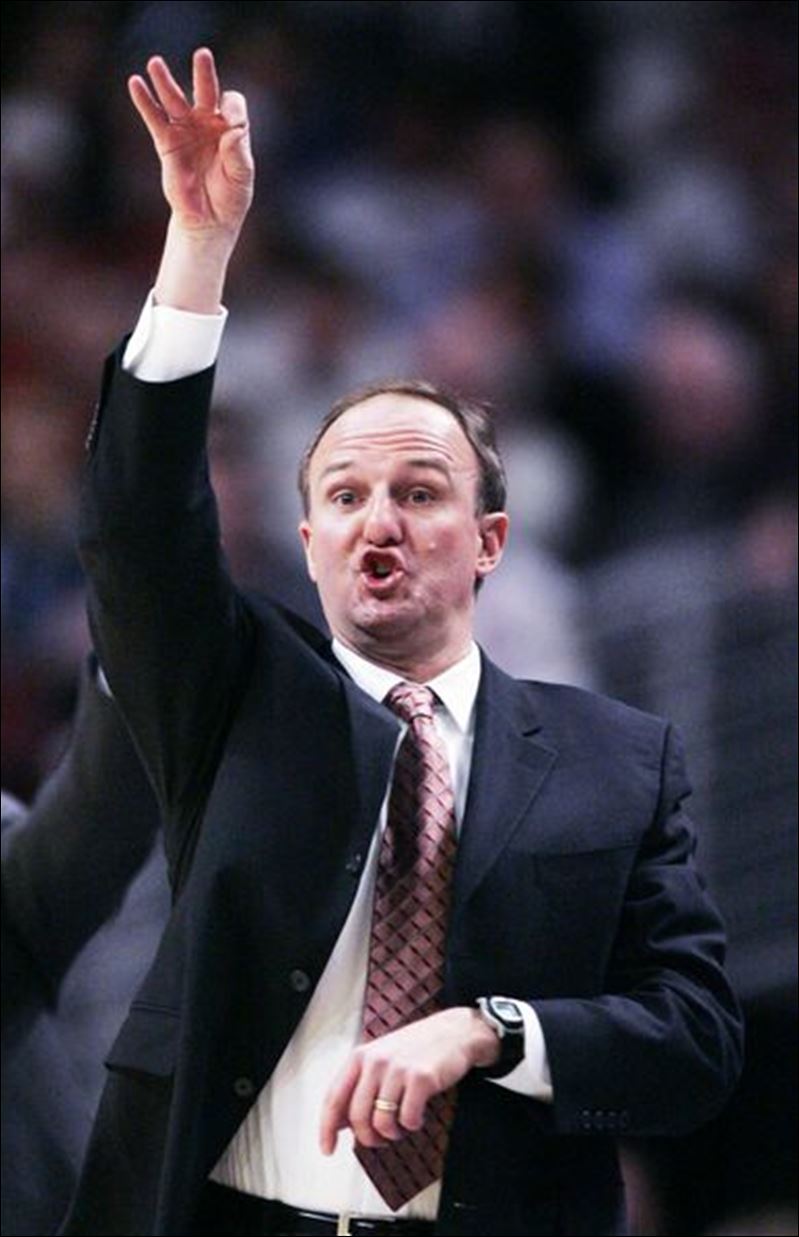
That's the spirit, Thad! But be
careful not to shoot too many.
21 points scored on 20 three-point shots
32 points scored on 35 two-point shots

Aha! Now we have a mismatch: it seems that long-range bombs are about 15% more efficient in the long run than the good ol' jumper. I think  the next logical thing to examine would be whether or not a law of diminishing returns can be applied, i.e. if shooting more than a certain number of three-point shots makes the efficacy of the shot diminish, as on a bell-curve.

Food for thought (scoring composition in brief):
  • Kentucky: 77.9 ppg, 17.1 ppg off 3s, 43.6 ppg off 2-pointers      
  • Louisville: 68.4 ppg,  17.6 PO3/g, 36.4 PO2/g
  • Kansas: 74.2 ppg, 17.4 PO3/g, 41.2 PO2/g
  • Ohio State: 75 ppg, 15.1 PO3/g, 39.1 PO2/g
Now we get to investigate the law of diminishing returns as it applies to the three-point shot. We already guessed that Average U. takes about 18-20 three-pointers per game. Virginia Military Institute (VMI) has been known in recent years for launching an absurd amount of triples: the Keydets have averaged more than 26 attempts per game in each of the last six years, registering as high as 40 in 2006-2007. However, they haven't made the NCAA tournament even once during that time, another proof that extremism in any form is generally not a good thing.

Of the teams in the last four Final Fours, here's where they ranked in 3pt attempts:

2012                    3PA/G         Rank
Kentucky  ?             15.1          288
Louisville  ?           18.5          143
Kansas     ?          16.8          217
Ohio State ?          15.1          286

2011                    3PA         Rank
UConn*               17.5          195
Butler                 21.2          52
Kentucky            18.6          145
VCU                    22.9          20

2010                    3PA         Rank
Duke*                    19.6          105
Butler                    20.0          81
WVU                    20.1          80
Michigan State     14.7          306

2009                    3PA         Rank
UNC*                    17.8          175
Nova                    18.4          149
UConn                  13.4        325
Michigan State      14.9          296    

2008                    3PA          Rank
Kansas*               16.9          250
Memphis               21.6          68
UNC                    14.9          313
UCLA                    15.6          301

*=champion

As the stats show, the teams from the non-major conferences - VCU, Memphis and Butler (twice) - relied on the long ball to reach the Final Four, but all of the winning teams shot fewer than 20 three-pointers on average.  The only team since 1998 to win it all using the three-pointer as a dedicated weapon was the 2001 Duke Blue Devils, who shot 26 threes per game and were officially an offensive anomaly with four starters - Jay Williams (42.7%), Shane Battier (41.9%),  Mike Dunleavy (37.3%), and Chris Duhon (36.1) - shooting lasers from three-range and averaging more than 27 points per game combined on deep shots alone. [With the support of Battier and Williams sinking 256 combined treys, the team set records for most three-pointers made (407) and attempted (1,057) in a single season.] The only other recent year any team has even had two staters in that neighborhood was the following season, when Mizzou's Clarence Gilbert (38.4%) and Kareem Rush (41.6%) combined to average over 18 ppg on three-balls.

And from all this madness, I've learned...what? Well, it seems like putting up more than an average number of 3s per game is a bad idea unless you have the most talented shooters in the world, though I suppose that's somewhat self-evident. Anybody wanna guess how many 3-pointers Kentucky put up in their last loss? That'd be 28. And Louisville? 23 attempts in their most recent loss to Syracuse.  Interestingly enough, Ohio State and Kansas have not surpassed 20 three-point attempts in any of their last three respective losses. Might a deep-ball drought spell doom for the Bluegrass teams, given Louisville's comparative lack of offensive firepower & Kentucky's method of being judicious from distance? You could draw that conclusion & rationally decide that picking the winner of the Kansas-OSU game might be a safer bet**. Or you might make that pick based just on what color you flipped a coin for, red or blue. Me? I'm just nuts enough take the Buckeyes.

**(Wait: does this mean extremism as it applies to efficiency - either really inefficient or totally effective - is a bad thing? Well When there's a bias in favor of balance, as I have consciously or subconsciously identified here, even good efficiency in the long-term is dangerous, because nobody is safe from "one bad night.")

Tuesday, April 6, 2010

The Last Underdog...?

I thought Butler would win.  I really did.

But nothing is ever certain, a lesson I learned the hard way during high school football.  I've been lucky enough to experience a lot of great sports moments in my life already - a goal-line stand, a game-winning field goal, a walk-off grand slam, a hole-in-one, and a buzzer-beater are all events I've witnessed or participated in.  I've seen two of my favorite teams win championships, and I've been to an NCAA basketball regional final.  I guess I don't have as much room to complain as some, but the two things I really want the most are a World Series ring for the Orioles and a true Cinderella story.  The former is still at least a few years away, but I've been painfully close to the latter on multiple occasions, the latest coming last night.  I still remember seething about Davidson's loss to Kansas in the '08 tournament, taking out my frustration on the hoop above my garage for a good 45 minutes after the game.  I wanted nothing more than to do the same after the Devil buzzer sounded. Too bad the gymnasium doesn't stay open that late.  

This will sound familiar, but I feel robbed.  I know there were circumstances that could have prevented Butler from being in that position at the end of the game, the most prominent being enough bricked free throws by players not named Hayward to build a small tomb for Butler's bulldog mascot.  Still, it kills me to think that they did all that work for six months to come up a few inches short, inches that were well-deserved, too.  Even Maryland's furious comeback against Michigan State was not as worthy an effort as Butler's tough-as-nails, shot-for-shot bout with Duke.  If only that team were not so darn likable - Babyface Hayward, Mustache Howard, Missile Mack, the always lurking Veasley, Nored the fingersmith, Stoneface Stevens.  That doesn't even include Jukes, the Alabama transfer and charity founder who stifled Zoubek for much of the game, or Hahn, the little engine that dropped a big trey in the first half.  Vanzant scrapped for those loose balls because his life depended on it
.
Maybe we'll feel feel better about it if we find out in two years that there were all kinds of NCAA infractions committed by this team, but we would probably just feel more duped.  Some things seem to defy all our attempts at coping and our best-faked better-luck-next-year mentalities.  This one stings the most because we don't know that we'll ever see it again.

If the NCAA tournament expands to 96 teams, as the ESPN crew working the NIT Finals hinted last week, a so-called "underdog" team would have to win five games in ten days just to make the Sweet 16, making a Final Four run all but impossible for a Butler-type team.  It means more money for the NCAA and first-round byes for the top 32 teams (most of which will probably hail from major conferences), but it will ruin the competitive balance that it has maintained so well up to this year.  There's already one matchup that is almost impossible to win (although Princeton nearly upset No.1 Georgetown in the first round in '89), so if a team seeded worse than No. 80 somehow makes it to the round of 64, how are they even supposed to compete? It's no contest.

I'm almost convinced that a "Cinderella" story will never be transplanted into real life.  In each recent March Madness case, there were players who carried their teams (Jai Lewis for George Mason, Stephen Curry for Davidson, Gordon Hayward for Butler) to success, each one with the good fortune of playing close to home (Washington DC, Raleigh, Indianapolis) and each one ultimately coming up short of the biggest goal.  (Even this year's Cornell team couldn't beat a tough Kentucky squad while playing in Syracuse.)  All of these teams try desperately to fit the mold, and all have fallen short.  These conclusions beg the question: how spectacular will the odds be when a non-major team finally overcomes them to win it all?  Or will the next team win it, the last in a line of slow progression from Sweet 16 to Elite 8 to Final Four to National Championship game? It's difficult to say.

To be frank, I think I would die a little bit on the inside if the tournament format changed. Here we have the closest thing in college sports to a fair shake for postseason-caliber teams, and to throw away the integrity of such a system for a bump in revenue runs counter to the uniqueness of collegiate athletics.  Are we willing to reduce the opportunity for pure competition to solely the high school level and rec leagues? What happened to the singularly American experience of playing organized team sports with complex strategy while representing an institution, an idea you stand behind?  There's nothing like it anywhere else in the world, and to alter it irreparably would be doing unspeakable damage to the "maybe" factor of the sport, eliminating the unlikely possibilities that even now are more real than we think.  It will be a sad day when that time arrives, and my fear is that it's not too far away.  If that's the way it is, here's to Butler for keeping our hearts for as long as they could.  We may never see another team like them.

Monday, March 29, 2010

Cinderella to the Palace

The Butler Way is defined on the school's website as "teamwork, working hard, giving selflessly, having fun and making a difference."  Idyllic as it sounds, it's not difficult to see those qualities in those who play and coach on the Bulldog basketball team.

Giving selflessly: check. Guards Shelvin Mack and Ronald Nored average a combined 7 assists per game.

Working hard: check. Forward Gordon Hayward collects over 8 rebounds per game in spite of his lean physique (6'9", but only 207 pounds).

Having fun: check.  Head coach Brad Stevens is a willing supporter of showing a little spirit.


As for teamwork and working hard, you would have to be living in a doghouse to not have heard what these Bulldogs have accomplished.  Despite sharing their state with Larry Bird's alma mater, two Big Ten schools and Touchdown Jesus, Butler has built a program that has won its last 24 games in a row (leading the nation) and was ranked in the national Top 25 polls for most of the regular season.  The Bulldogs' small-time conference background (the Horizon League, formerly known as the home of Valparaiso and Bryce Drew), was proved irrelevant when they beat Big Ten champ Ohio State and Sweet 16 qualifer Xavier in back-to-back games in December.  Yet in spite of all they accomplished, Stevens' team still carried the underdog label all the way into March, the "liberal arts university" with only 4,000 students that was still more famous for its historic Hinkle Fieldhouse, the filming location of the sports cinema classic Hoosiers, than for its own team playing in that building.

In the space of 4 games and 11 days, the Bulldogs showed us again, like Davidson and George Mason before them, why this tournament is so much fun.  During the first weekend, they beat No. 12 seed UTEP in the opening round and downed No. 13 seed Murray State in the second round to propel them to their first Sweet 16 in 3 years.  Those wins were not hard to believe, but when senior forward Willie Veasley hit a 3-pointer and tipped in a Mack miss to give his team a six-point lead with under a minute to play against No. 1 seed Syracuse, people started talking.

What if?

It's a question that Stevens simply would not ponder during a wildly successful regular season, one that he managed to stave off until after the win over Murray State. Now that Butler had matched its highest threshold of success seen in this decade, why shouldn't he fantasize about how cool it would be to take out the No. 1 seed in their region?  What did they have to lose?
     
A minute later, the Bulldogs found themselves two halves of All-American basketball away from a Final Four berth.  Even more astounding was their timing: what are the chances that of all the arenas in the country, this year's host site happened to be Indianapolis, just five miles from their very own campus?  Might that have been extra motivation for their matchup against second-seeded Kansas State? 

Call it luck if you can't believe it.  Call it fate if you can't understand it.  Call it good basketball if you like, for that's what it really is.  Any way you slice it, the Butler Way shines through. At the end of an evening of stifling Bulldog defense, punctuated by two Nored steals in the last 30 seconds of Sunday's game against Frank Martin's Wildcats, you saw the Butler Bulldogs boarding a flight from Salt Lake City to Indianapolis with a West Regional trophy in hand.

It's not an original plot line, at least not in concept, but somehow, that doesn't make this journey any less exciting than the ones before it.  And it's not done yet.

To quote a younger Gus Johnson: "The slipper still fits!"
--

Mountaineering With a Vengeance
What was it like to watch Kentucky's debacle with West Virginia on Saturday night in a Memphis restaurant? (Shout out to Central BBQ!)

I'll tell you. Righteous euphoria, the kind you haven't seen since Shaq nanny-nanny-boo-booed Kobe by winning the NBA crown with Miami in '06.  In a well-occupied dining area dominated by a projection screen TV, the enthusiasm with which Memphians cheered on the Mountaineers proved just how much hate and hurt was left over from the Calipari era.  Every time Cal appeared on screen, boos and jeers echoed from almost every booth and table, and when West Virginia pulled ahead near the end of the game, there was almost a standing ovation, cheers that didn't celebrate Bob Huggins' crew as much as they applauded Calipari's demise.

Had the John Wall and Wildcats made the Final Four, it would have been a crushing blow for a city that was unfairly stripped of all its basketball success because of one man's transgressions, but thankfully, justice was served, at least for this year. (Watch out Kentucky. I've said it once already - you make the bed you lie in.)  I hope I get to see the same level of enthusiasm for a successful Josh Pastner-led Tigers' squad sometime before I graduate, and my gut says it will be sooner rather than later.  Can't wait.

Spartan Resilience
Michigan State's bid to Indianapolis marked Tom Izzo's sixth trip the Final Four in twelve seasons. My question is, does that really surprise anyone? The guy's only been doing this for fifteen years straight - drawing in a solid group of recruits, teaching them to rebound and play hard-nosed blue-collar basketball in one of the best facilities in America and eventually pushing them to be 20+ win teams.  In his tenure, Izzo has yet to go a full four years without making the Final Four.  That means every recruit signed by Izzo that has continued to play basketball all four years and matriculated academically through his senior year has played in the Final Four.  I don't see how anyone can turn down an opportunity like that.  So, uh, if I all-but-guaranteed you a spot in the Final Four a year or two from now, would you take it?  The real question is why you wouldn't take it.  How man people can say they've played in the Final Four? Not many that I know.  I'm surprised high schoolers haven't started camping outside HIS house, Cameron Crazies-style, just to be able to show him their face.  He's the one with all the talent (pun intended).

As you might have guessed, I'm rooting for whoever wins the Butler-MSU game.

Thursday, March 25, 2010

Hurtin' in the Home of the Terrapin

 It still hurts.

If you didn't see Maryland's devastating 85-83 defeat against Michigan State on Sunday, then I know your pain.  I was on a plane when the game ended, and having seen the halftime score, reading the final tally in a text message when we landed was like taking a big gulp of a drink too strongly mixed.  Would I rather see us lose by 8 or 10? No. Hell no. The effort they made in that comeback was worthy of a win. I see where Mike Wise is coming from with the whole "fitting end to an up-and-down career" for the seniors, but poetic justice only goes so far, and I'm not satisfied with that loss.  They deserved better. Vasquez worked especially hard to be the player and floor leader that he showed he was on Sunday (26 pts, 8 assists, 4 rebounds, 3 steals against the Spartans), and for him to go out like that . . . nuh uh. Not a worthy send-off.  I wouldn't care as much if they lost in the Sweet 16, but to not even make it to the second weekend is pretty weak.  It's crummy for Hayes and Milbourne, too, one seriously under-appreciated and the other grossly overshadowed by his backcourt despite having been forced to play out of position for 3 years.  Wise is right that an era of Maryland basketball is ending, just as it did with the graduations of Juan Dixon and Steve Blake, but it sure isn't the ending we wanted.

So what do the Terps have to write home about for this season? They have an ACC championship shared with Duke that was made possible by a signature home win on national television against a team they hate. They are fortunate enough to have had the ACC Player and ACC Coach of the Year.  They won seven in a row to end the season and rallied from halftime deficits for road wins at Florida State, NC State and Virginia Tech in February.  Shoot, there was even a thrilling buzzer-beater finish at home to slay Georgia Tech.  We saw the emergence of a Lonny Baxter-like low post figure in Jordan Williams, something Gary's been missing for years.  None of this even mentions the solid class of recruits slated to arrive in '10.  The future looks bright.

Most of all, these Terps didn't turtle.  They didn't falter after a loss to William & Mary.  They didn't succumb to pity after an embarrassing loss in Durham.  They didn't bring the disappointment of their ACC tournament exit with them on the plane to Spokane.  And staring at a 15-point deficit with less than nine minutes remaining in their tournament life, they clawed and scratched and fouled and swished and stole their way back into the lead after playing their hearts out for 99.75% of the game.  The soul-crushing .25% of the game that remained drove a spike through my chest the size of Vasquez's hair gel bottle, but in no way could I have asked any more from those guys than what they had already given.  Milbourne's pose in the post-buzzer photos speaks to that: hands on the sides of the head, completely (forgive the pun) shellshocked, having no idea what else could have been done to win that game.

Nothin' left to do, Landon.  Y'all gave it your best shot. Sometimes you trick the bull, but sometimes the bull gores you.


--


Now, having given the Terps their due, I'll try to settle up my bracket. Red indicates airballs, yellow is bricks, and green means count it.

  • Montana led at the half, but the No. 14 Grizzlies couldn't hold off No. 3 seed New Mexico (half credit for saying they would win 1 game).  Anthony Johnson, hero of the comeback against Weber State, went 1-for-12 from the field and missed all four of his 3-point attempts, amassing a lowly six points.  Here's a shocker - averaging 19 PPG in the Big Sky conference is not quite as applicable to the NCAA tournament as you might think! (Springs, you dummy, a kitten could have picked that right!) Yeah, well, no tears shed. Long shots are just that.
  • Oklahoma State point man James Anderson shot 0-for-6 from deep and 3-for-12 inside the arc for a total of 11 points (hang on, there's not a patten here, is there?) in a pillow fight loss to Georgia Tech in which nobody scored more than 14 points.  Disappointing, dude, especially when my buddy A-Dick claims you're a good guy.  I guess it didn't help that the Pokes got outrebounded by 11. That Lawal-Favors combination can getcha, I know. But you forgot. Rule #72: No excuses, play like a champion.
  • UTEP started strong but ultimately underwhelmed a Butler team (jury's still out) I thought to be very beatable.  Derrick Caracter showed well (20 points, 9 boards, 10-13 shooting), but I think the Miners fell victim to their lack of depth in losing a six-point halftime lead. Memphis, where are you?! (Oh, you lost to Ole Miss in the NIT did you? Nice work guys. Yeesh.
  • The fact that I upchucked violently on St. Patrick's Day after one drink (don't ask) was not a good sign for Notre Dame.  When you play on the low block and average a double-double in the Big East for most of the regular season, it's not okay to lay an egg in the first round game of a tournament which you need to dominate in order to have a chance of being looked at by NBA scouts.  Regardless of Tory Jackson's 2-for-11/1-for-7 performance while playing all 40 minutes, Luke Harangody's 2-of-9 shooting performance and 3 personal fouls doomed the Irish as sure as Mike Brey's blazer-and-turtleneck combination cost him 3.1 dates per year in college.  See if I ever pick the Irish to the Elite 8 again (highly improbable unless my next bowl of Lucky Charms turns into a pot of gold).
  • Cal beat Louisvile on the backs of their threesome (Randle, Christopher, Robinson), but the Golden Bears were overwhelmed by Duke's threesome (Smith, Singler, Scheyer). Imitation is a sincere form of flattery, but that doesn't mean it will get you places.
  • BYU continues to fall short for me.  I said they had the best chance to win the MWC and get a No. 3 seed. They didn't. I said Jimmer would be the gas for their Sweet 16 go-cart, and they puttered out.  Fredette scored 21 against Kansas State, one point below his season average, but his 38% shooting from the field was sub-par when the Cougars needed an all-star.  He may have just secured a spot as one of the 15% of BYU students who aren't married by the time they graduate.
  • Gonzaga didn't make the second weekend; still, Mark Few continues to receive (and decline) high-profile job offers.  I admire his loyalty, but he better take his team places soon before people begin writing him off (shoot, I already started).
  • Cornell knocked off Temple and Wisconsin, proving they are stil the upset-minded team that almost took down Kansas earlier in the year (foreshadowing a future Kansas loss to a mid-major).  I'm excited to see the Big Red in the mix and I'll be pulling hard for them against Kentucky.  Look for Louis Dale to make some noise - he's an Alabama native, and they don't take kindly to SEC foe.
  • West Virginia and St. Mary's are both doing well, particularly the Gaels who stunned No. 2 seed Villanova in a Big East arena on the broad shoulders of Omar Samhan (32 points, 7 rebounds).  West Virginia should make the Elite 8, and I wouldn't be surprised if Samhan and Co. does as well - Baylor and Washington are both beatable teams.
Picks for The Second Weekend
I'm still going off of my original bracket, and my Final Four remains intact as of right now (Ohio State, Syracuse, Duke and Kentucky, with 'Cuse beating Duke in the final).

Predictions
  • Pitt beats Kansas State and 'Cuse tops Butler to set up an all-Big East regional in the West, which the Orange win.  Arinze Onuaku should try to play against Pitt, but I think Wesley Johnson can carry the load against the Bulldogs.
  • Ohio State bests Tennessee and faces whoever dares step on the court (I picked Kansas - oops).  UNI vs. Sparty will be fun to watch, but neither one will take down the Buckeyes on Sunday (although Michigan State would be the greater challenge).
  • West Virginia beats an over-matched Washington team and Kentucky manages to barely stifle a tough Cornell team, and the 'Cats squeak by again in the regional.  Realistically, I can see a UK-WVU matchup going either way.
  • Duke ends Purdue's chip-on-the-shoulder power trip with a dominating performance from Kyle Singler which can't be matched due to the absence of Singler's foil, Robbie Hummel.  I'll go out on a limb and say St. Mary's beats Baylor (I took 'Nova) - I really think they have it in them, and that would set up the ultimate mid-major-vs.-juggernaut rivalry, a fiesta for underdog sympathizers of all ages. Duke wins.
Wishlist
  • I'd love to see Cornell beat Kentucky, even if they get no further (although a Final Four berth that goes went through John Calipari AND Bob Huggins would be insanely cool). It's a simple good-over-evil, straight-over-sleazy fantasy for fans dealing with the ethical dilemmas of modern recruiting, one-and-done prospects and special player privileges.
  • It would be awesome to see UNI Farokhmanesh the daylights out of Michigan State (yeah, I said it), but secretly I'll be waiving a small Sparty flag for Tom Izzo. He does things by the book, and he doesn't take himself too seriously. Gotta love it.  
  • I hope Chris Kramer and Purdue stick it to the Devils, even if that busts my bracket. They have a much better shot than any other team Duke will face except maybe Syracuse.  If Baylor wins the other game (which I wouldn't mind seeing) and Purdue somehow gets by, I would be glued to the TV just as much for Tweety Carter, LaceDarius Dunn and E'twuan Moore as I would be for a Duke-St. Mary's matchup. Those are the best two possibilities in that region.

Saturday, March 13, 2010

The Drop on the Draw

It is THE most wonderful time of the year. And I'm missing it.

Yes, we've arrived at March once again and all the wild college basketball games that go with it.  Sadly, I'm going to be out of the country for rounds 1 and 2. At this point, you're surely asking yourself if Springs has gone off the deep end; I myself will certainly feel that way on Sunday and all next week.  An island village in Costa Rica, however, is a locale rarely available to the average college student, so I lunged at the chance.  Given that I don't think I'll have access to an international phone, I'm giving my picks to the gracious twin, who has promised that he will submit them on my behalf.  Given that I'm going into Selection Sunday with a significant level of blindness, I'll have craft a gameplan based on seedings and my opinions of already all-but-in teams.  Without further ado...
  • There will be at least two No. 1 seeds in the Final Four. Science, logic, duh.
  • At least one No. 10 seed will beat a No. 7. Again, pure science, aka the completely unquantifiable feeling in my gut.
  • Maryland will make the Sweet 16. I believe they have the potential to reach the Elite 8, but I'm not getting my hopes up. However, anything less than the second weekend will be serious blueballing of a very unfair variety.  Oh, and no other ACC team will make the second weekend, aside from Duke (and they may not even make it).
  • UTEP will make the Sweet 16. Five players average double-digit point totals.  Randy Culpepper is silly athletic, and Louisville transfer Derrick Caracter is a solid inside presence.  Imagine if you had him in the frontcourt together with a guy like Samardo Samuels. Doesn't that sound great? Hey, wait a second. . . . .
  • If Montana gets a No. 14 seed or better, it will pull the upset.  Anthony Johnson went off the map to beat Weber State, and I believe he can do it again.
  • Calipari hasn't won a championship yet, and he won't do it with this crew. (Even if he does, it's just gonna get investigated and forefeited 3 years from now, right? Sorry UK - you make the bed you lie in.) And for good measure, Duke won't win either.
  • Oklahoma State will win its first round game. James Anderson has Stephen Curry-like potential (no one can truly replicate '08, but people will come close), and I can see the Pokes possibly getting to the Elite 8 on his back, but an early KO by K-State in the Big XII tournament didn't help their confidence.
  • California is better than people say. Randle, Christopher and Robinson will show up. They will win their first game.
  • Notre Dame makes the Sweet 16 if it gets better than a No. 7 seed (i.e. No. 6 or No. 5); if not, they might be one-and-done.
  • BYU gets to the Sweet 16 on the basis of good shooting and the fact that every announcer has to love saying "Jimmer" 20 times a game. He's gotta be around at least 3 games!
  • New Mexico will win its first round game. Beyond that, I have no idea. Lack of size has hurt Maryland in past years, but to win 25+ games with two 6'8" guys down low is some brand of amazing. We'll have to see how it goes.
  • Butler and Gonzaga go no further than the sweet 16, if that far. Biggest mid-major teases of all time.
  • Ohio State will make the Final Four. I don't remember the last time I saw confidence like that which Evan Turner displays. He's Greivis Vasquez on steroids, or Greivis is the poor man's Turner. Whichever you prefer. I like the former.
  • West Virginia's hot. Da'Sean Butler probably makes another buzzer beater before people realize they have to cover him. Hello, Sweet 16, how do you do.
  • Cornell is my other waffle team with New Mexico. They hit a ridiculous number of 3-pointers the other night to win the Ivy League. That kind of thing is also extremely hit-or-miss on any given night. They're capable of winning on Thursday/Friday, but it's less likely that they'll do so on Saturday/Sunday. I don't know what to do with them.
  • Saint Mary's will usurp Gonzaga's place as best WCC team - they will make the Sweet 16, and should keep the third game competitive to the end.
To all y'all competing bracketeers: best o' luck. The Madness begins. Here's hoping that if you must get busted, it will be memorable.

Wednesday, March 10, 2010

Maryland-Duke Retro Diary: Reliving the Shootout

If you’re like me, you’re still living in the past, that being Maryland’s thrilling upset of No. 4 Duke last Wednesday night and their subsequent share of the regular season ACC title. Hungry for some more celebratory Terps stories? Then sit down, read on, and enjoy these next few minutes.  On the eve of the ACC Tournament, I present to you the grossly informal and somewhat lengthy game log that I wrote during last week's contest in College Park. This is what the view looks like from the mountaintop.
--

1ST HALF
Moments before tip-off

Oh man this crowd is loud! The seats are just a wave of pulsing gold all the way up to the roof behind the basket. I feel like I’m on Danny Glover’s toilet in Lethal Weapon 2. This is intense!

Maryland wins the tip, and Eric Hayes starts the scoring with a floater.
We’re on the board! The student section is bouncing off the ceiling right now.

Duke misses their first two threes.
Promising opening. Maybe they won’t hit one all night.

19:02 Greivis Vasquez takes a bad shot and reminds us he can still be the same idiot who called out John Calipari’s Memphis squad before their matchup in last year’s tournament. If you don’t remember how that went down, good.

18:45 Kyle Singler gets blocked by Jordan Williams. Nice. That’s a tone-setter. This kid is really something for a freshman. He’s almost averaging a double-double on the season (9 points, 8 boards), and he’s reached double digit points or rebounds (or both) in each of the last 5 games.

17:46 Jon Scheyer misses an open 3. Is that his 2nd miss in a row? That’s lucky.

16:09 TV TIMEOUT MD 10-2
This is a conspiracy! The refs stopped the game to fix the nets right when we have all the momentum. Unbelievable. Maryland always catches these bad breaks when they’re doing well. I’m steaming like a blue crab. Let’s go!

Singler hits a long 3 right out of the timeout. Hear that? It sounds like the air slowly beginning to trickle out of the Terps’ balloon.

15:04 Hayes with a reverse baseline layup. There we go! Good pass underneath, Greivis.

14:32 Nolan Smith misses at the other end. Rebound Sean Mosley, Terps on the break with numbers. What if I hit the pause button on the Tivo right now? Wouldn’t that suck? Watching it in slow motion might be even worse. . .
Vasquez flips a no-look pass to Williams for the dunk over Scheyer. And 1.
BOOM! Seriously thunderous. He is a steamroller of a man. That’s poster-worthy. Scheyer flopped like a wet noodle; he may have to change his shorts. Williams hits the free throw - off the glass, for good measure. How late is the bank open on Wednesdays?

13:28 Another breakaway. Cliff Tucker gets the putback off the initial miss. We’re running a good transition game so far!

11:43 TV Timeout MD 21-8
By the way, what’s with the patterning on Duke’s jerseys? Very weird. (Apparently it’s supposed to look like the Gothic architecture on Duke’s campus.) Didn’t think Coach K would go for that; then again, it may not have been his call.  Money talks, but Nike money screams like a Scheyer-faced banshee.

8:34 Brian Zoubek takes a charge on Vasquez? C’mon! There’s no way he set his feet!

8:21 Singler travels. ‘Bout time they called that.

8:10 Zoubek called for the foul. That’s 6 on each team.

7:31 Zoubek gets a putback from an offensive rebound that Gregory should’ve had. Guys, we can’t do that! We may win in spite of his play, but let’s try not to let him dominate like he did in Durham (16 points, 17 rebounds).

6:50 Zoubek grabs another board put misses the tip and comes down holding his hand like he jammed a finger. What a puss.

6:42 Hayes hits from deep!
Duke timeout, MD leads 30-19
I don’t like this. Zoubek was way too involved in the last 4 minutes. I won’t wish an injury on anyone, but I’m not gonna complain if he stays out. . .
The replay shows Zoubek’s hand in more detail. Wow, that finger is really crooked. Dislocated. That actually hurts.

6:22 Airball by Smith. He’s gonna hear that all night. Let’s not forget that this crowd once took verbal shots at J.J. Redick’s younger sister. Compared to that, Smith should be happy that he’s being hounded with “AIIIIIIIIIIIIR-BAAAAAAAAAAAALL” calls.

5:53 What’s a Plumlee brother doing hitting a 3? That isn’t in the scouting report. Duke still down by 11.

3:24 Hayes with an overhead soccer-style pass from near midcourt thru traffic to Mosley at the baseline. He’ll shoot 2. Nice dish, dude! That had some mustard on it. TV timeout, MD 36-26
Mosley hits both, exits for Vasquez.

3:10 Singler for 3. Rats.
Is Duke playing a zone defense? Since when do they do that?

2:35 Hayes cuts backdoor, feeds Williams underneath. If Hayes has a signature move, it’s a flawless backdoor cut and a stroke from outside. Pete Carril, are you listening? This kid’s perfect for Princeton!

2:09 Hayes misses a 3. Zoubek’s back and looks awkward.
1:44 Zoubek called for the offensive foul! Two on him, Scheyer and Thomas.

1:11 Smith hits a 3. Timeout Maryland. The lead is five, 40-35.

0:41 Scheyer hits a 3 from the corner. $#!+@%&. Duke within 2.
Duke is still in the 1-2-2 or 3-2, can’t tell which. We’re holding for the last shot.

0:02 Mosley airballs AND it’s a shotclock violation. They’re gonna Give duke the ball. Great. Just peachy. The fans messed him up on that one - they were a second ahead of the actual clock in their verbal countdown. Come on y’all!


HALFTIME
Maryland 40, Duke 38
We’re up, and that’s good, but the mo’ is slipping a little. We have to come out strong in the 2nd 20. MD shot roughly 50 percent from the field and 40 percent from 3 in the first half. Everybody on Duke had at least one foul, too. So far, we’re taking care of business. Don’t let up!
FSU beat Wake tonight, which can only help the Terps even though Georgia Tech lost to Clemson last night. 19 Wake turnovers and no points for Al-Farouq Aminu. Yikes.


2ND HALF
Duke gets the first 2 baskets. Ughhh.

Blue Devils are back to playing man to man. Vasquez hits a floater to start the MD scoring.

18:15 Singler blocked by Landon Milbourne, but Smith steals it away from Hayes. Their ball. Duke timeout, tied 42-42. We haven’t heard a lot out of Milbourne tonight. As a senior playing in his final home game, I suspect we will soon.

Singler scores, and Duke has their first lead of the night at 44-42.

17:47
Offensive foul on Smith. Good work Mosley! He’s been matched up on Singler (giving up 4 inches in height) all night and has done a solid job guarding him so far. Very underrated as a defender.

16:23 Zoubek rebounds a Scheyer miss. We gotta find a way to keep him neutral.
16:05 Another Zoubek rebound, this one from a Singler miss. Aaaaaah!

15:55 TV timeout. Duke 46, MD 44. This is not the fast start that we wanted to have coming back out of the locker room.

15:00 3 straight offensive rebounds for Duke. Guess who? Singler, Singler, Zoubek. Finally a foul is called on them. We just can’t keep letting them do that.

14:40 Vasquez airballs from outside. We are not strong right now. Maryland has only 4 points in six 2nd-half minutes.

14:05 Baseline skyhook off the glass for Williams. And 1! Tied again, 47-47.

12:40 Adrian Bowie steals the inbounds pass from Scheyer, fastbreaks the other way and puts in a lefty scoop shot after switching hands in the air. Sweetness! Are those his first points of the night? You betcha.

12:10 Tucker feeds a driving Milbourne for a one-handed slam! Oh baby that was big! The student section is bananas right now.

11:00 Duke timeout. Terps up by 6, 54-49. Zombie Nation on the loudspeakers, gold shirts bouncin’ – now THIS is Terrapin Basketball!
Vasquez goes to the bench. Gary’s resting him for the final push.

9:11 Smith hits the lean-in jumper and 1. Tied at 54. Vasquez, Hayes and Williams return to the floor. Here we go, boys!
8:39 Smith draws another foul on the drive, no basket. He misses.

8:04 Smith hits the teardrop.

7:51 Timeout MD. Duke leads 56-54. Smith has scored the last 7 for Duke.

7:43 Vasquez draws contact from Smith. He hits both free throws. Tie game. MD runs full court press, but Duke navigates it well. Devils outrebounding the Terps 12-7 on the offensive glass thus far.

6:25 Singler draws the foul on the drive. Timeout Maryland. Duke leads 59-58.
He misses the first, makes the second.

5:58 Mosley to Hayes on a great backdoor cut! He is SO good at that.

3:42 Vasquez runner off the glass! They Terps have lassoed back the lead, 67-65. Timeout Duke.

2:25 Hayes cuts to the basket and gets the friendly home-court roll .

1:09 Smith and Scheyer both miss chances at 3. Rebound Vasquez, who moves the ball slowly into the offensive half. MD up 71-69.

0:39 Vasquez takes Scheyer off the dribble from outside the arc. He drives diagonally, crossing the lane and throwing up an absurd circus-shot runner from the far side with basically no shooting angle at all. It bounces up off the iron and goes down.

MD 73, Duke 69

About half a second later, I lost it.

Regardless of your allegiance as a fan, that shot ignited either raw exhilaration or throw-up-your-hands-in-frustration incredulity. Given the circumstances, it could be considered as a legitimate candidate for Clutch Shot of the Year; in some cases, the game itself has been dubbed as the year's best, due in large part to that play. In fact, that play may have sealed Vasquez's bid for ACC Player of the Year, since Scheyer was the one defending him. In her post-game column on Vasquez, ESPN’s Dana O’Neil described the shot as “sensationally insane,” a “how-in-the-world-did-that-go-in, off-balance, back-footed jumper from deep in the corner” that was, by all accounts, “vintage Vasquez.” In his SportsCenter highlight call, Stuart Scott used just three words (as only Stu can): “Greivis. Vasquez. Ri-DIC-ulous.”

After that, it was a matter of fouls and howls. The game was won there on that play. Of course, that didn’t stop me from worrying through the last 39 seconds, but once it was done, I was so pumped that I couldn’t go to bed for a whole 3 hours. We had beaten Duke, and we had done so in much the same way I had suggested prior to the game.

FINAL: Maryland 79, Duke 72
Nice work, fellas. Let's see if we can't do it again in the ACC tourney. Woo!

Wednesday, March 3, 2010

Maryland-Duke: A Plan for the Terps to Take Control of the ACC

These days, there are only two things that even begin to rival the hatred that Maryland students have for Duke University.  One of them is the ridiculous amount of snow left over from recent storms that absolutely refuses to melt.  The other? Mid-term exams.

As you might have guessed by now, the Blue Devils (25-4, 12-2 ACC) are Public Enemy No. 1 this week, and will surely be the center of attention on Wednesday night as they take on the Terrapins (21-7, 11-3 ACC) in College Park with the ACC title and their Top 5 national ranking hanging in the balance.  The Terps lost 77-56 in their first meeting with Coach K's kids in Durham on February 13, but they rebounded from that loss surprisingly well.

The Terps proceeded to win five in a row after the loss, including victories over conference heel-nippers Georgia Tech (on a buzzer beater, no less) and Clemson at home, and Virginia Tech in Blacksburg (in double overtime).  Since the loss at Duke, Maryland has shot 48% from the field and nearly 45% from behind the arc; they have also rallied from deficits of 10 (on the road at NC State) and 15 (against Clemson) to close out two 9-point wins, which speaks to their resilience, perseverance and ability to make adjustments at halftime.
 
In order to win, they will have to out-shoot the Blue Devils and get them foul trouble in order to put pressure on Duke's shallow bench.

In Duke's last two losses (all four have come on the road, by the way), their opponents (NC State and Georgetown) have shot a laser-like 58% and 71% respectively from the floor, though neither opponent won the rebound battle.  The Blue Devil starters compiled 32 fouls over those two games, an average of 16 per game or just more than 3 per player.  Drawing contact may not keep Duke's best three players off the floor (Nolan Smith, Kyle Singler and Jon Scheyer each average over 17 points and 35 minutes per game), but it will make them play more carefully on defense, which can allow Maryland to be more physical and aggressive on offense.

The knocks on the Terrapins are that they don't have the size to hang with the Blue Devils on the inside, and they can't keep the Big Three from doing significant damage.  It's true that 7-footer Brian Zoubek mauled the Terps inside (16 points, 17 rebounds) in the last meeting. It's also true that Scheyer, Singler and Smith combined for nearly 60% of Duke's points on February 13.

The fact is, if Maryland is lights-out from the floor, none of that will matter.  NC State lost the rebound battle by 15 (no player had more than five) and they won the game by 14.  Georgetown let the Triplets rack up 54 points (70% of Duke's scoring) and won by 12.

This game can be had.  For the Terrapins, it's hit or miss.  If they can take this game and beat Virginia on Saturday, the Terps will be rooting hard for North Carolina to pull the upset against their familiar Tobacco Road foes.  A Tar Heels win would have Maryland take home the regular season crown.

Monday, February 1, 2010

February Fast-Forward: Who Will Get The #3 Seeds?

At this point in the college basketball season, the top teams are pretty well established and identified as potential top seeds for the postseason NCAA tournament in March.  The polls are fairly good indicators of this consensus, as they generally have the same few teams pegged in the top spots. According to a combination of the AP and USA Today polls and RPI rankings, the best teams to this point have been Kentucky, Kansas, Villanova and Syracuse; close followers include Michigan State, Duke, West Virginia, Purdue, Georgetown and Kansas State.  Beyond these top ten, however, it's considerably more difficult to say which teams can best compete with the best competition. Here are a few teams to watch out for in the coming month.

Texas (AP #6, ESPN/USA Today #6, RPI #19; 18-3, 4-2 Big XII)
Many fans would rank the Longhorns in the same flight with the aforementioned Top Ten, but a home loss to AP #24 Baylor this past Saturday and a close win at Texas A&M-Corpus Christi earlier in the season prove that this team is not indomitable. Rick Barnes' squad is 2-3 against current top 25 schools, and with six Big XII road games still to play, including the end-of-season rematch against Baylor, seniors Damion James and Dexter Pittman will have to continue to carry the load to combat the inexperience of their young backcourt.


BYU (AP #12, ESPN/USA Today#12, RPI #17; 21-2, 6-1 Mountain West)
The Cougars are undefeated at home this season, and their only two losses have come against Utah State (16-6, first place in the Western Athletic Conference) and league rival AP #23 New Mexico. BYU can shoot the lights out--they rank in the top five nationally in field-goal shooting, free-throw shooting and 3-point shooting--and that can only help them come tournament time.  With junior point guard Jimmer Fredette pouring in 21 points per game and averaging five assists as well, this team could cement a #2 or #3 seed in March if they continue their stellar play into February.


Temple (AP #15, ESPN/USA Today #15, RPI #15; 18-4, 6-1 Atlantic 10)
Despite losing 2009 All-A10 guard Dionte Christmas to the professional ranks, the Owls are still contending for the A-10 regular season title because of guards Ryan Brooks and Juan Fernandez (28 PPG and 6 APG combined) and big man Lavoy Allen, who's averaging a nice double-double of 10 points and 10 rebounds per game.  Temple boasts a victory over cross-town rival #3 Villanova and a plus-minus record of 8-2 (eight road wins, 2 home losses) among the accomplishments on their resume, but with Xavier, Charlotte, Rhode Island and Dayton all gunning for the two-time defending A-10 champs, a three-peat will be very difficult.


Wisconsin (AP #16, ESPN/USA Today #16, RPI #14; 16-5, 6-3 Big Ten)
The Badgers are known for playing well at home, and this season has been no different--all of their losses have come on the road.  They split their games with conference rivals AP#20 Ohio State and AP#10 Purdue and have played well considering their strength of schedule ranks 14th nationally. If they can beat Michigan State in Madison and get past Michigan this Saturday, senior guard Trevon Hughes (16 PPG) and company have a good chance of running the table and setting themselves up in prime position for a #3 seed in March Madness.

New Mexico (AP #23, ESPN/USA Today unranked, RPI #13; 20-3, 6-2 Mountain West)
If you had to guess which conference had two 20-win teams as of this past weekend, there's a good chance you would not have said the Mountain West.  The Lobos, who are neck and neck with BYU for the conference lead, have four players averaging double-digits in points per game and enjoy a distinct home advantage because of the notoriously high decibel levels in University Arena (aka "The Pit"). If junior do-it-all Darington Hobson can maintain his balanced performance (15 PPG, 8 RPG, 4 APG) through the coming month, his team might be able to sweep the season series from the Cougars (they play in Provo on February 27th) and gain the top spot in the conference tournament.


Vanderbilt (AP #21, ESPN/USA Today #23, RPI #9; 16-4, 5-1 SEC)
Led by senior guard Jermaine Beal (14 PPG), the Commodores also have three other players that score more than 10 PPG. Their downfall is that the aren't very deep, and with games against #14 Tennessee, #1 Kentucky and AP #18 Mississippi still to play (the latter two in a three-day span), the next month could tax this team to exhaustion.  If they can stay healthy and get through February at .500 or better, the 'Dores could still have a chance at the #2 seed in the SEC East, meaning they wouldn't have to face John Calipari's Wildcats until the SEC tournament championship. If they make it that far, they've got a great shot at #3 seed in March.

Monday, December 7, 2009

MMA: Monday Morning Address, 12/7/09

1) What the Raiders are doing these days is nuts. 27-24 over the Steelers in Pittsburgh?! Absolutely bonkers. Bruce Gradkowski (20/33, 308 yards, 3 TDs) is doing a better Brett Favre imitation than I've seen anyone do in a long time - did you see the 23-yard wounded duck he threw to Louis Murphy to set up the winning touchdown? Steelers corner Ike Taylor needs some serious pine time. 'Atta boy, Bruce!

2) I cannot believe UNC lost to Calipari's 'Cats. I'm gonna be sick.  What a bad week for the ACC - Duke can't get past Wisconsin (granted, the Badgers are good at home, but c'mon, this is Duke we're talking about here) the Heels lose a stinker in Lexington and the Terps turn it over 19 times in a 9-point loss to No. 3 Villanova that was otherwise a decent game. Yuck.

3) We should all feel awful for TCU and Boise State, but worse for Cincinnati.  They pulled off a furious comeback to win the Big East crown over Pitt and what did they gain? A non-championship bowl berth against Tim Tebow and the Gators in Florida after Alabama made Tebow cry on national television.  That game will be a blow-out however it turns out: either Tebow gets mad like he did after the loss to Ole Miss last year, or he throws in the towel to keep himself healthy and his draft stock high. I'm not a betting man, but I'd put my money on Tebow to come out and dominate.

4) Anquan Boldin proved once again last night why he's the most devastating No. 2 receiver in the league. He's got an easy job playing second fiddle to Larry Fitzgerald, but I can see why he want's out of Arizona - he's got all the skills every NFL coach from Oakland to Tampa Bay is dying to have.

Wednesday, December 2, 2009

Tiny Terps 2010: Despite Youth, Maryland Should Be "Dancing" Next Year

Finally!

I know what you're thinking, and I'm thinking the same thing.

It's been a while since the Maryland Terrapins had a decent basketball recruiting class.

At the moment, Gary Williams' Terps stand 5-2 heading into a weak stretch in their non-conference schedule (besides their matchup against Villanova on Sunday). The bad news is that the Terps will likely have to win the rest of their non-conference games (and they should) to have a shot at the NCAA tournament in case conference play goes badly.  The good news is that the Terps are playing well right now: seniors Greivis Vazquez, Eric Hayes and Landon Milbourne are all averaging double-digit point totals, and freshmen forwards Jordan Williams and James Padgett are collecting over 13 rebounds per game between the two of them.  The even better news? The freshmen will be supplied with some quality helping hands next year.  At least, that's how things look from here.

According to a major basketball recruiting website, Maryland has gained commitments from four players for the 2010 season.  These commitments include point guard Terrell Stoglin, shooting guard Terrence Ross, small forward Mychal Parker and power forward Ashton Pankey, all of whom are rated as three- or four-star prospects (out of five).  The last time the Terps signed that many quality recruits was in 2007, when the incoming class included guard Adrian Bowie (currently averaging 3.4 points per game) and wing Cliff Tucker (5.7 PPG).

The obvious follow-up question becomes "Will these kids be as good as the experts predict?" The 2002 recruiting class, coming on the heels of a national championship, included many players of similar caliber as this year's recruits.  Maryland fans remember names like Travis Garrison, Chris McCray, Nik Caner-Medley and Mike Jones, all of whom were solid players but never achieved the high marks set by the likes of Juan Dixon, Lonny Baxter, Chris Wilcox, Steve Blake and Byron Mouton in '02.

To say the least, it's going to be difficult for the 2010 squad to replicate whatever success this year's team will have.  Hayes is a sure-handed three-point shooter and passer and Milbourne is a lanky rebounder who also has touch from outside the paint.  Vazquez is the kind of do-it-all player that is incredibly hard to replace if your school is not named Duke or North Carolina. It's not unreasonable to project the Terrapins to be ACC bottom-feeders next fall, but given the young talent on next year's presumed roster, they have the potential to be good. Will this next incoming class have success in year 1? I think so. 

The 2010 Terps will return with Bowie, Tucker, Padgett, Williams and knockdown shooter Sean Mosley (13.1 PPG this season) in addition to the four-man recruiting class.  Mosley will be the dominant offensive force, but he won't be the only one that opposing teams have to stop.  Stoglin is a scoring guard who should be able to take some of the pressure off Mosley, and Ross could be a dangerous secondary three-point shooter.

I know this is a long way away, but, if things fall into place and all four of these players matriculate to College Park, I see no reason why the Terps won't get a bid to the NCAA tournament in the spring of 2011.

Thursday, November 19, 2009

Quick Hits

1) I'm not sure whether it's the system, the hype or the player, but Darrius Heyward-Bey has to change something, and quick.  The No. 7 overall draft pick has only 6 catches in 9 games and has yet to break 100 total yards for the season, much less have a 100-yard game.  I know everybody said he was drafted too high when the Raiders took him, but I hate seeing him disappoint like this.  I watched him play against my high school when he was a senior, and unfortunately, I saw what a lot of people saw: he was fast, sure, but for he got outjumped by a 5'11" kid (DHB is 6'2") and never showcased the homerun capability that he actually displayed for a little while at Maryland.  Maybe he's not being used the right way; Maryland got him the ball on a lot reverses and trick plays that let him use his speed in the open field, and I haven't really seen that in Oakland. Maybe he doesn't quite click with Jamarcus Russell, but you would think they would get along, a strong-armed passer with a fleet-footed receiver, both of whom are under a lot of pressure.  Whatever it is, he's not gonna have a j-o-b if he doesn't start putting up numbers soon.

2)  This whole business with protecting the quarterback is getting out of hand, especially considering the things quarterbacks are now doing to opposing players. Consider Brady Quinn's low block on Terrell Suggs on Monday Night Football. Yes, Quinn got flagged and fined, but only after consider commotion from Ravens players who were understandably irate when they found out that Suggs had partially torn his MCL and couldn't play this coming Sunday against the Colts.  If we're talking about protecting people, defenseless receivers should be the ones keeping coaches awake at night.  They're the ones skying for balls ten feet in the air without being able to see who's coming to hit them.  They're the ones whose eyes are always tracking a moving object, tracking, tracking, tracking.......til BOOM! They're on the ground courtesy of the opposing safety.  Ask a player whether he would rather run a pattern across the middle or drop back in the pocket, and I bet you he takes the pocket most of the time.

3) Watch out for Memphis basketball this season. And no, I'm not living in the past - at least not that past.  The "past" I'm thinking of is Josh Pastner, newly appointed savior/coach of the now Calipari-less program.  Coaching as the head man in only his second game ever, Pastner managed to walk away from #1 Kansas with a two-point loss, which is pretty good for a team that looks nothing like the ones of the previous two years that have made deep runs in the NCAA tournament.  Pastner is enthusiastic, experienced and effective.  He's been coaching since he was 16 (he coached an AAU team to a national championship as a teenager), he's already recruited a top three class of seven players for next season, and his optimism is so overflowing it borders on the ridiculous.  What's not to like?  If guys like Pierre Henderson-Niles and Roburt Sallie can contribute on a regular basis, the Tigers will dominate Conference USA as if nothing changed between last spring and now.

Thursday, August 20, 2009

"Manning" Up

Before school starts, a few diddlies on the NFL, as in (Peyton) "Manning" Up, and other sports-related events:

-Tomorrow begins one of the best sports weeks of the year for me: the Little League World Series. If you're wondering, yes, I was watching the regional final between Mass and Rhode Island and that was an epic walk-off grandslam the kid hit to win the game. That kind of magic can only happen when you're twelve years old. It's special. Who am I pulling for? Mercer Island, WA. Why the heck not? It's Little League, and it's awesome.

-Thank God Roger Goodell suspended Dante Stallworth for the season, but Plaxico Burress gets 2 years for shooting himself in the leg? Someone on ESPN said it best, something to the effect of "Jail is for people who do bad things," and Burress is not one of them. He shot himself, by accident. He didn't run a dogfighting business, and he certainly didn't kill another man with his car while driving drunk. Where is this world headed? This Burress thing should have been open and shut a while ago - 1 year max sentence, probably less, community service about gun violence. How difficult is that?

-Watch out for Oklahoma State on the gridiron. Can't exactly call 'em sleepers, but they could be in the BCS mix come January. The three-headed monster of Zac Robinson, Kendall Hunter and Dez Bryant can prove nasty if they stay healthy. Offensive shootouts galore at the OK Corral. Go 'Pokes!

-Brett Favre will lose to the Packers at least once this season, but he will also lead the Vikings to the NFC Championship. 40 years old or not, torn bicep or whole, he will find a way. I'm sticking my neck out here, Brett. Get to it!

-Kentucky basketball fans, congratulations - you're about to be sick. Your fab five for this season are about to be trained and coached by the only coach to ever take two different schools to the Final Four and get in trouble for violations both times. Don't think you're immune, even if you do make the Final Four. You hired him, you have to live with him. Cal, you're a cheat, and your haircut belongs on a used car salesman. What goes around comes around, and it's coming to you, buddy. Just wait.