Monday, May 14, 2012

On Retirement: Athletes and The Grass That Grows "Over the Hill"


It hasn't been all smiles
for Darrell Waltrip since
he retired from NASCAR.  
I was drawn to an article written late last week by Marty Smith, ESPN’s lead NASCAR reporter, who took time in his column to chronicle the emotional and financial struggles of former NASCAR greats like Dale Jarrett, Rusty Wallace and Darrell Waltrip. Smith’s piece included supplementary perspectives from retired professionals like driver Ricky Craven, NBA center Brad Daugherty, and others, but the crux of his work examined the idea that “athletes die twice.” Smith credits the aphorism to comments made by longtime sportswriter John Feinstein on a Charlotte radio show in reference to the recent suicide of retired NFL player Junior Seau. From ESPN.com:

“Feinstein expounded on the comment by noting that, upon retirement, the world as a professional athlete has always known it no longer exists, and that he or she must completely relearn how to function in society. He then cited the difficulty many former athletes experience in the taxing attempt to acclimate themselves to what most of us consider normal.

“The stringent nature and structured routing required to achieve professional sporting excellence is no longer necessary. And even more dynamic than that, the doting adulation and attention from fans, media, family and most everyone else in their midst vanishes. Just like that.”

In his column, Smith noted that Wallace and Craven suddenly found themselves unable to pay for all the things they once could. Jarrett said the depression-like emotions he battled in early retirement contributed to his divorce. Waltrip struggled mightily with the idea that his late-career performance didn’t mirror the success of the 80+ wins he’d accumulated between 1975 and 1992.  As triumphant and driven as they’d been on the track, the inability to sustain that prosperity and sense of purpose made their racing “after-lives” painfully unfamiliar.

By comparison, former NFL defensive lineman Trevor Pryce seems to be handling the early stages of retirement with a little more skill. At 36, he’s not even 18 months removed from a 3-tackle performance in the New York Jets’ loss to Pittsburgh in the 2011 AFC championship game. But while Pryce, a father of three, can relate to feeling similarly rudderless in the open water beyond his football career, he doesn’t seem quite as troubled as some. From NYTimes.com:

Having retired way before my time, I have started to lose focus and drive. At times, I feel ostracized.
           
“…Starting from scratch can be unsettling. If you’re not prepared for it, retirement can become a form of self-imposed exile from the fulfillment and the exhilaration of knowing you did a good job…

“During the six-month off-seasons [during my career], I pretty much educated myself, dabbling in music, Hollywood, journalism, real-estate and everything in between, with varying degrees of success. I was able to do a lot in so little time. Now that I have all the time in the world, it’s amazing how little I accomplish every day…

Trevor Pryce is a little unsure about his
retirement, but he's working to figure things out.
“Don’t cry for me, though. I’m getting used to it slowly and will be content with my new life. That is, until [Jets coach] Rex [Ryan] calls.”    

One point made elsewhere in the Pryce and Smith pieces was the importance of age and tenure in the retirement process. “[For] Most of us competitors... you’ve [competed] for a very long period of time, and that will and desire to compete doesn’t just go away,” Jarrett tells Smith. But there is a spectrum to that “very long period.” A man like Waltrip, who drove amateur races as a teenager, finds himself beyond the half-century mark with the daunting knowledge that the one thing he’s been trained to do for the better part of 40 years is now no longer his profession; he’s almost twice as old as ball-sport retirees like Daugherty and doubly tethered to his primary skill set.  The older they get, the harder it is to teach dogs new tricks.

In talking to Jarrett (age 55, retired at 51), Wallace (55/48), Waltrip (65/52), and the others, Smith made it clear that none of them really understood the impact of that lifestyle change, how it would more or less wrench the fabric of their existence right out from under their feet.  All of the men spoke to similar psychological problems that handicapped their efforts in post-retirement life: lack of focused competition, departure from community/peer group, financial losses, decreased attention from fans, and overall, a paralyzing feeling of inadequacy and not knowing how or where to ask for help. 

If there were an obvious solution to helping retirees in their second careers, the answer would seem to be education, an objective the NFL has already identified. I’ve definitely wondered whether or not the existence of so many NFL players’ charitable initiatives is a requirement of league by-laws, but depending on how involved the player is, I suppose it could also serve to expose the athlete to a business-like infrastructure that they don’t see in weekly practices or one-on-one contract negotiations with their front office. I’ll have to do more digging into that to see if players’ foundations are somehow mandated by the country’s only professional non-profit sports league. 

I don’t know nearly enough about NASCAR to even begin to think of ways that its veterans might benefit from some sort of post-racing training — shoot, for all I know, such a program already exists, and the struggles of these lifers simply surpass the knowledge delivered therein.  Nonetheless, it’s distressing to read a column like Smith’s, where there is no apparent answer for dealing with a lifetime of success that seems to have suddenly fallen out of one’s pocket. To be fair, these drivers have had their share of nights with bright lights and days with bulging wallets, far more than the average joe who works a 40-hour week for 40 years and gets to retirement a whole lot later.  But considering the early end met by Seau and others who battled post-career demons, the most responsible move would be to putting even more emphasis on making drivers and other athletes aware of the fiscal and mental challenges that face them once their primary careers are finished.

“The idea of doing nothing — that’s the American Dream, right? That’s called retirement?” Craven told Smith. “It’s a lonely place.”

Nobody should be lonely at the end.

Monday, April 30, 2012

Daric Barton & The Art of Fielding

This really isn't about about Chad Harbach's 2011 novel, though I highly recommend that book, especially to anyone who's ever attended a D-III college or played baseball. But on a related tack...

As Daric Barton proved Sunday, even the best
fielders aren't immune to the occasional bad game.
The Orioles trailed the Athletics yesterday by the count of 2-0 to begin the top of the ninth inning.  Oakland starter Bartolo Colon had shut down the O's for eight innings, collecting four strikeouts through 28 batters faced and 95 pitches thrown. The seven Orioles in Sunday's batting order who had participated in the nine-run shelling of A's starter Tyson Ross on Saturday were, by my count, a combined 6-for-21 (.286) on the day, and nobody had made it past second base. Colon was proving again why he is still valuable at age 38: a truly good starting pitcher can be nearly unflappable when he's in the zone.

However, the O's hadn't flinched. Tommy Hunter turned in a strong outing on the mound, allowing two late-inning runs after completing the first five unscathed. Darren O'Day had worked a 1-2-3 eighth inning and Pedro Strop had managed to keep the margin from growing in the ninth despite allowing a one-out double to pinch hitter Daric Barton.

To be sure, the pitching stats in this game were not "defense-independent," a distinction that many statisticians like the make in this era of SABR metrics.  In the fourth inning, Mark Reynolds, making his first start of the season at first base, fielded a sharp grounder down the line and whirled to turn an impressive 3-6-3 double play with J.J. Hardy for outs 1 and 2. The very next batter, Seth Smith, was gunned down at second on an assist from right-fielder Nick Markakis after his grounder hit first base and jumped over a diving Reynolds.  To start the following inning, left-fielder Nolan Reimold robbed A's catcher Kurt Suzuki of a homerun by reaching over the top of the left-field wall to make the grab.  Adam Jones got the next out with a sliding catch in center to keep Eric Sogard from reaching base. The fielding behind Hunter seemed to be aces all around.

But perhaps the most important defensive play for the O's happened in the final frame. With Strop on the hill, Barton on second and Smith on first after a one-out walk, Suzuki popped up to second baseman Robert Andino for the second out. The next batter, Sogard, grounded a ball to the right side. Reynolds muffed his chance, and the ball scooted through his legs onto the outer infield dirt. Andino was Johnny-on-the-spot, fielding the ball as it skittered away and tossing to Strop, covering first for the inning's final out. Had Andino failed to back up Reynolds on the play — a duty that tends to get overlooked, particularly when fatigue is a factor later in the game — Strop would've had to work at least one more batter in a bases-loaded situation, and that assumes Barton, who was probably running hard with two outs, hadn't scored from second on a play that would've otherwise been ruled an error.

Here's the kicker: the fielding wasn't done being the fulcrum of the game.

After the A's were retired in the top half, Barton went out to play first base in the bottom half after his pinch-hit appearance. Barton has only played two full seasons at the Major League level, both for the A's: the last time he did it was 2010, when he hit .273 and ranked first in the American League in putouts and Range Factor per nine innings, second in fewest errors committed and Total Zone Runs per nine innings, according to Baseball Reference. In 122 chances at first base this season, Barton had not made an error. He's the most experienced first baseman on the A's — it made absolute sense to put him out there in the bottom half. In fact, manager Bob Melvin had done it two days earlier, when Barton was inserted at first before the bottom of the 8th without being asked to pinch-hit beforehand; the A's won that game, 5-2.

Sunday, however, was a different story for Barton.  The first batter in the bottom of the ninth was J.J. Hardy, who sent Colon's 2-1 pitch on the ground back up the middle. Given that the San Francisco Chronicle's Susan Slusser seems to be the only major writer to have highlighted Barton's late-inning blunders (or at least, the most prominent Google search result), I'll let her narrate the action once the ball left Hardy's bat.

From SFGate.com's blog "The Drumbeat":
The first grounder was to Eric Sogard’s right and he made an off-balance throw to first base, but the ball took a big hop in front of the first-base bag, usually a play Daric Barton makes easily. He couldn’t handle the throw, and J.J. Hardy was awarded an infield hit.
With one out, Adam Jones hit a tapper to Colon’s right and Colon, who is usually a decent fielder, picked up the ball and rushed the throw, throwing what looked like a hard and pretty tricky bouncer past Barton.
That’s the one Barton really felt he should have had; he said he wasn’t sure if it was going to hit on the dirt or the grass, but he pulled at it a little too much and it went by him.
“I should have had ‘em both,” Barton said. “That’s my job, especially if they’re putting me in for defensive purposes.”
It was ruled a hit for Jones, and an error on Colon for Hardy advancing to third. That meant that all subsequent runs [scored by the runners on base, Jones and Hardy] were earned [and charged to Colon].
In case you missed the final three batters, Colon exited after his error in favor of closer Grant Balfour, who quickly blew the save by giving up a two-run double to Matt Wieters and a game-winning homerun to Wilson Betemit two batters later.

To be fair, the job of anyone fielding an infield ground ball is two-fold: A) field it, or at least keep it in front of you by any means necessary, and B) get it to the proper base as quickly and precisely as you can. Sogard's throw was rushed, and Colon's was sub-par for a veteran player; that said, Barton has probably seen lots of those throws throughout his career, and in a tight game like that, those are plays he must make in order to preserve the win. If he scoops only Sogard's throw, Jones arrives at 2nd base alone with two outs and the O's still down 2-0, with Wieters representing the tying run at the plate rather than the winning run.  If he somehow picks Colon's throw with Hardy at first, Hardy gets to second alone with two outs and Wieters at bat; either way, the endgame strategy likely changes for Melvin with two outs already in his pocket. Maybe he leaves Colon in to face Wieters. Maybe Balfour enters as as he did and still gives up a double to Wieters — with the tying run now on second and two outs, does he walk Chris Davis, now the potential winning run, just to set-up force-out opportunities at second and third? Probably not.


But, like Barton's bobbles, those scenarios all died in the post-game box score. With one play ruled an infield hit and another called a throwing error on Colon, Barton's fielding percentage remains a sparkling 1.000, tops in the league.  It's a strange day when the stats say you're perfect but the tape says otherwise.

"Some games just don't work out," Melvin told Slusser afterward.

Indeed. Some games feel quite like fiction.

Tuesday, April 17, 2012

Non-Sports Post: Jabari Greer, advocate for fatherhood

Here's the LINK: "Hometown Saint"

The shortened URL above will take you to an article I wrote a few weeks ago on New Orleans Saints cornerback Jabari Greer and the non-profit foundation he's started to promote fatherhood.

I got the chance to meet Mr. Greer at a free movie screening in his hometown of Jackson, TN while covering the event for my school's student newspaper. Judging by the things he said over the course of the evening and our own brief dialogue, my overall impression was that he's more thoughtful than your average joe. (Further proof: he's cerebral enough that he dares to express himself in verse on his blog.) Maybe that's not what you might expect from a man who has played for a coach that preached unapologetic intentional violence as a primary tactic, but even in that light, Greer made sure he identified himself and his fellow Saints as "fathers, professionals, and men of integrity," individuals who are not bound by the cruel instructions of a few bloodless overseers thirsty for victory.  Players, let's not forget, are the ones who do the hitting, not the coaches.

Tuesday, March 27, 2012

2012 Final Four Preview: Is the "Trifecta" a bad bet for Kentucky and Louisville?

I get distracted a lot, mostly by sports-related topics that non-sports people would find boring (the one-and-done rule, the NFL's tax exemption as a non-profit, the various ways to throw a curveball, etc.). On some occasions, I find myself to have a sudden fascination with numbers, though I am wretched when it comes to keeping track of figures.  However, my lack of arithmetic skills aside, I have a certain curiosity about efficiency and the ways in which things are done. I attended a lecture by Moneyball guru Paul DePodesta a few weeks ago, and he emphasized the importance of asking what he termed the naive question (which he credited to a man named Peter Drucker):

"If we weren't already doing it this way, is this the way we would start?"

Hitting "trifectas" is usually a jackpot, but shooting
too many could spell disaster for Kentucky or Louisville.
So I thought about the three-point shot, specifically about how it figures into an offensive gameplan. The three-pointer has become the cliched "double-edged" sword of college basketball, particularly in March when teams are trying to rally from big late-game deficits in the NCAA tournament. If you went back and looked at every preview box for the 68 teams on the ESPN and Yahoo! Sports bracket challenge games, I swear you'd find at least 41.2657% of the analysis done on the team's chances included a mention of their prowess or deficiency in shooting from beyond the arc.  On its face, an offense built on knocking down 3s makes some sense. True, it's a lower percentage shot than your run-of-the-mill two pointer, but it's great for teams in need of a comeback, assuming they shoot it well. Example:


  • Situation: Comeback Kids are down by 12, four minutes to play, possessing the ball
    • Two-point solution: The Kids, who favor two-pointers, have to make six FGs (with almost no fouls committed by the Leaders) as quickly as possible AND play stellar defense a minimum of five times just to tie the game. At best, if they score in the first ten seconds of each possession and can't manage a steal but keep the Leaders from scoring, the Kids will get the ball with 15 seconds to play needing to score to tie the game. If they don't, they lose.
    • Three-point solution: The Kids, now favoring three-pointers, only have to make four consecutive shots (remember, the Leaders will mostly avoid fouling) and get three defensive stops in order to tie the game. Not only do the Kids have more time to mount a rally - more importantly, they have to do less in that time than if they were all shooting jumpers. At worst, the Kids can use their entire shot clock, defend without trying to steal the ball and still get possession with 30 seconds to play needing a three to tie the game. The best case scenario? If they don't steal but are still able to score in the first ten seconds of each possession, they'll tie the game with 1:45 to play and are certain to get the ball back, with a chance to win, at least two more times if they defend and rebound properly. 

I'm sure someone has come up with a stat to demonstrate the usefulness of a trey-centric offense (please point it out if you know it), but I wanted to run my own numbers for the sake of procrastination and satisfying my need to feel like some strange intrepid fan-sleuth.

Using TeamRankings.com, I looked up a bunch of the team shooting and scoring stats from the past 4-5 years and tried to determine a few things:
  • In a 40 minute game with a 35 second shot clock, there are about 68 possessions if every shot clock is used fully, giving each team about 34 shots in a given game. HOWEVER, teams often take very early shots, especially with the prevalence of fast-break offenses and man-to-man defenses now-a-days. Consider:
  • The average NCAA Division 1 men's basketball team shoots about 55 times per game from the floor.
  • The average team FG percentage is roughly 42.5%.
  • That said, keep in mind that the average team also shoots about 20 3-point shots per game. (Sounds high, right? It is, a little bit - the real figure is about 18 per game. But these calculations are pretty rough, gimme some leeway for a moment.)
  • On those three-point shots, the average team hits about 35%.
So...

20*.35 = 7 three-pointers made per game = 21 points from 3-land
55-20 = 35 two-point attempts per game

In order for the overall team FG% to be around 42.5%, the % from two-land has to be slightly higher to balance out the 35%, right? Sure. After a few trials, I found 46.5% to be a valid input here. (Not surprisingly, the actual 2pt percentage for average teams is about 47%).

Therefore, 35*.465 = 16 two-pointers made per game = 32 points the old-fashioned way

If at this point you think that 3-pointers are not as valuable as 2-pointers, you'd be right where I was about twenty minutes ago. Then I thought about the discrepancy between the number of attempts, so I looked at my numbers in terms of points per shot:
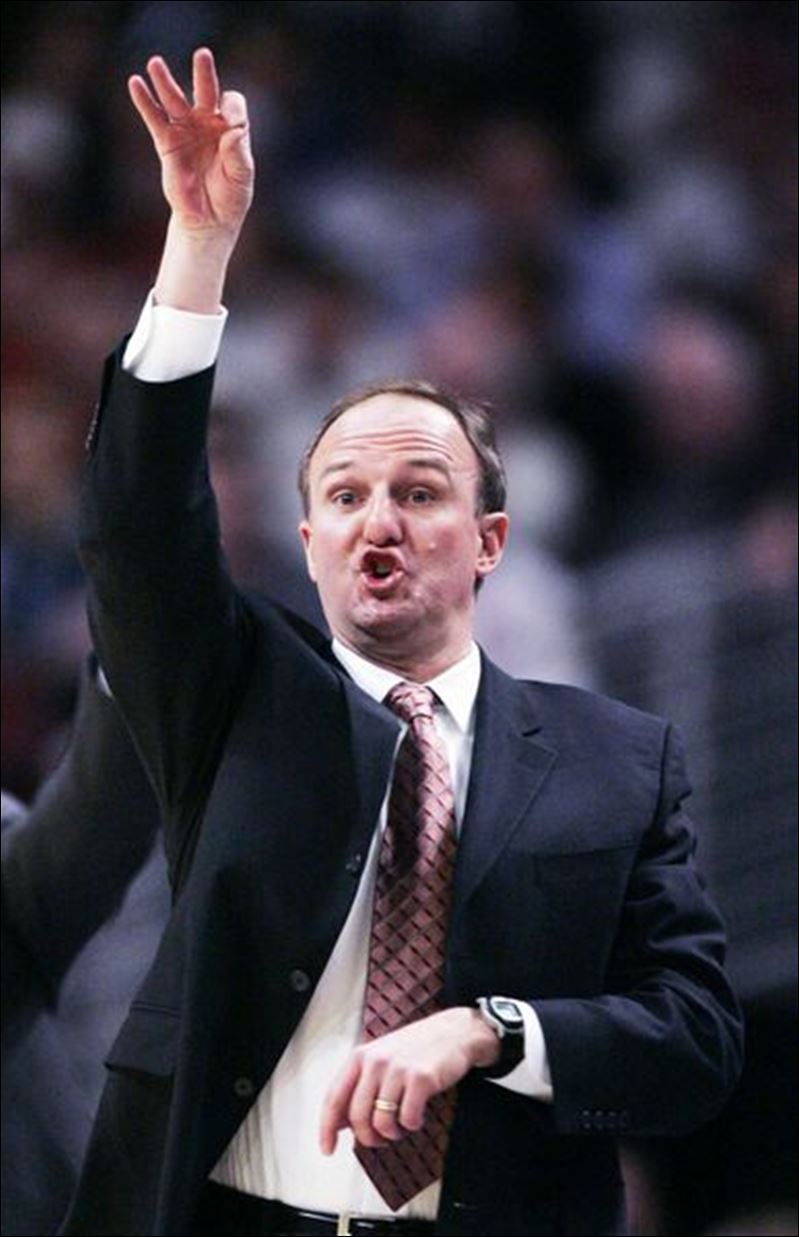
That's the spirit, Thad! But be
careful not to shoot too many.
21 points scored on 20 three-point shots
32 points scored on 35 two-point shots

Aha! Now we have a mismatch: it seems that long-range bombs are about 15% more efficient in the long run than the good ol' jumper. I think  the next logical thing to examine would be whether or not a law of diminishing returns can be applied, i.e. if shooting more than a certain number of three-point shots makes the efficacy of the shot diminish, as on a bell-curve.

Food for thought (scoring composition in brief):
  • Kentucky: 77.9 ppg, 17.1 ppg off 3s, 43.6 ppg off 2-pointers      
  • Louisville: 68.4 ppg,  17.6 PO3/g, 36.4 PO2/g
  • Kansas: 74.2 ppg, 17.4 PO3/g, 41.2 PO2/g
  • Ohio State: 75 ppg, 15.1 PO3/g, 39.1 PO2/g
Now we get to investigate the law of diminishing returns as it applies to the three-point shot. We already guessed that Average U. takes about 18-20 three-pointers per game. Virginia Military Institute (VMI) has been known in recent years for launching an absurd amount of triples: the Keydets have averaged more than 26 attempts per game in each of the last six years, registering as high as 40 in 2006-2007. However, they haven't made the NCAA tournament even once during that time, another proof that extremism in any form is generally not a good thing.

Of the teams in the last four Final Fours, here's where they ranked in 3pt attempts:

2012                    3PA/G         Rank
Kentucky  ?             15.1          288
Louisville  ?           18.5          143
Kansas     ?          16.8          217
Ohio State ?          15.1          286

2011                    3PA         Rank
UConn*               17.5          195
Butler                 21.2          52
Kentucky            18.6          145
VCU                    22.9          20

2010                    3PA         Rank
Duke*                    19.6          105
Butler                    20.0          81
WVU                    20.1          80
Michigan State     14.7          306

2009                    3PA         Rank
UNC*                    17.8          175
Nova                    18.4          149
UConn                  13.4        325
Michigan State      14.9          296    

2008                    3PA          Rank
Kansas*               16.9          250
Memphis               21.6          68
UNC                    14.9          313
UCLA                    15.6          301

*=champion

As the stats show, the teams from the non-major conferences - VCU, Memphis and Butler (twice) - relied on the long ball to reach the Final Four, but all of the winning teams shot fewer than 20 three-pointers on average.  The only team since 1998 to win it all using the three-pointer as a dedicated weapon was the 2001 Duke Blue Devils, who shot 26 threes per game and were officially an offensive anomaly with four starters - Jay Williams (42.7%), Shane Battier (41.9%),  Mike Dunleavy (37.3%), and Chris Duhon (36.1) - shooting lasers from three-range and averaging more than 27 points per game combined on deep shots alone. [With the support of Battier and Williams sinking 256 combined treys, the team set records for most three-pointers made (407) and attempted (1,057) in a single season.] The only other recent year any team has even had two staters in that neighborhood was the following season, when Mizzou's Clarence Gilbert (38.4%) and Kareem Rush (41.6%) combined to average over 18 ppg on three-balls.

And from all this madness, I've learned...what? Well, it seems like putting up more than an average number of 3s per game is a bad idea unless you have the most talented shooters in the world, though I suppose that's somewhat self-evident. Anybody wanna guess how many 3-pointers Kentucky put up in their last loss? That'd be 28. And Louisville? 23 attempts in their most recent loss to Syracuse.  Interestingly enough, Ohio State and Kansas have not surpassed 20 three-point attempts in any of their last three respective losses. Might a deep-ball drought spell doom for the Bluegrass teams, given Louisville's comparative lack of offensive firepower & Kentucky's method of being judicious from distance? You could draw that conclusion & rationally decide that picking the winner of the Kansas-OSU game might be a safer bet**. Or you might make that pick based just on what color you flipped a coin for, red or blue. Me? I'm just nuts enough take the Buckeyes.

**(Wait: does this mean extremism as it applies to efficiency - either really inefficient or totally effective - is a bad thing? Well When there's a bias in favor of balance, as I have consciously or subconsciously identified here, even good efficiency in the long-term is dangerous, because nobody is safe from "one bad night.")

Monday, December 5, 2011

Climbing Mount Marino: Will Drew Brees Set the New NFL Single-Season Passing Yards Record?

At his current pace, Drew Brees would pass
for over 5,100 yards this season.
(Photo courtesy of Wikipedia)
"All hands on deck" should be the motto of every NFL team as they head into the final four games of the NFL season, but it should have particular resonance in New Orleans.  The Saints, winners of three straight, have an excellent chance to win the NFC South division crown, but to do it, they will need their offense to keep playing at a high level. And that means catching the football nearly every time it comes out of Drew Brees' right hand.

Much has been made of the assault, led by Brees, on Dan Marino's single-season passing yardage record of 5,084. Aaron Rodgers and Tom Brady are also within legitimate striking distance of the mark, but neither one has amassed yards quite so quickly as Brees this season.  Brees surpassed 5,000 yards once before in 2008, falling just an intermediate completion short of the No. 1 spot, but with a seemingly favorable schedule on his side and a very hot offense at the ready, Brees already seems to have been tapped by experts as the player to watch in this race.  However, there is a tortoise-vs.-hare element in the statistics that may prove crucial in determining whether or not Brees will be the one to set the new single-season passing record.

Here are the respective game logs for Drew Brees and Dan Marino in the seasons in which they threw for more than 5,000 yards:


Note that Brees was having a more prolific season individually in '08 than Marino in '84, but his team wasn't playing as well as Marino's Dolphins, nor was Brees being as efficient as Marino. In 12 games, Brees threw more interceptions and fewer touchdowns than Marino, and except for the drubbing of Green Bay and the shootout with San Diego, the '08 Saints defense and/or special teams gave up fewer than three touchdowns in each win and more than three in each loss.  Brees was pressed to make plays, and he took chances through the air: he hucked 11 interceptions in the first 6 losses, and averaged more than 45 attempts in each of those games (against only 33 on average in the first 6 wins). Still, Brees was in position to top Marino if even if he threw for only 304 yards in each of the last four games, and according to his yards-per-attempt pace, that would've required an average of 37 attempts per game to do this.  But that didn't happen. 

Here are the numbers from each player's last four games in their respective 5,000-yard seasons:   


 Again, Brees is shown to throw more often in the losses than the wins, probably because A) that's what the Saints under Brees have an affinity for, and B) they were behind in both games. Here's another befuddling tidbit: the pass defenses that Marino faced were ranked 20th, 4th, 22nd, and 5th respectively at the end of the season; between the four of them (1984 Jets, Raiders, Colts, Cowboys), they gave up an average of 197 yards per game through the air that season, though Marino's average for that four game stretch was a scintillating 351 YPG, including the 35-completion, 470-yard performance in the loss to the Raiders (the 4th-ranked pass defense that year).  

Brees, on the other hand, saw defenses that ranked 21st, 30th, 27th, and 16th against the pass. The per-game average for each of those teams (2008 Falcons, Bears, Lions, Panthers)? 226 YPG.  Brees' average against them in those four showings: 299 YPG.  Pretty ho-hum showing for a talented QB facing some below-average secondary units (which is not to devalue the quarterback position: it's very hard to throw for 300 yards, but Brees has shown he's capable of it on a regular basis, and for some reason, he didn't pull through this time). 

It should be noted that Marino had the benefit of a Miami defense that finished 7th in in the NFL in points allowed, whereas New Orleans would finish the 2008 season as the 26th-best in terms of scoring.  In the long haul, a lousy defense will assuredly hamper a quarterback's ability to perform at the highest possible level, as it inevitably forces the passer's hand to throw more often when the team is behind; additionally, when he does throw, many of the passes will likely be low-percentage tosses that are meant to gain yards in bunches rather than inches.

Here are Brees' current season stats for 2011:


Brees' numbers are up in virtually every category this season, the most important two being wins and attempts. The 2011 Saints defense ranks 19th in scoring allowed, which has undoubtedly helped their record, but the quarterback's average number of attempts per win (39.8) is still considerably less than the average in losses (46).  Brees' YPA stats (8.13) are also lower this year than in the first 12 games of 2008 (8.21) and thus nowhere even close to Marino's YPA of 9.31 for the first 12 games of the 1984 season.  

In the final four games this season, New Orleans is set to play Tennessee, Minnesota, Atlanta and Carolina, who are ranked 18th, 26th, 21st, and 15th, respectively; on average, they've given up 239 YPG, nearly 100 yards below Brees' season average and well below Brees' lowest mark thus far, a 258-yard day in the upset loss to the Rams.  Brees has thrown for over 320 yards in each of his 3 previous games, but to continue that kind of play will not be easy.  If the Saints clinch a playoff berth by winning their next two games, their tactics may change, and Brees may rest (if needed) in preparation for the playoffs. Then again, if they lose, he will have to keep playing and throwing more often than he would like, which will decrease his efficiency, making his run at Marino's record all the more difficult.  It's a trickier hypothetical than it looks, quite frankly. 

Even with the improved defense and the speed with which he compiled 4,000 yards, it's not safe to assume that Brees will finally  supplant Marino at the top of the list. From an efficiency standpoint, he's playing worse than in 2008, and if they're going to win the NFC South, it's in the Saints' best interest to make sure Brees isn't throwing more than 40 times a game.  If he does beat Marino's total, Brees will likely not be alone, nor will he be first in that category at season's end.  For those trying to find out which man is most likely to surpass 5,084 by the largest margin, efficiency statistics point to Aaron Rodgers, and it would be wise to examine his accomplishments in greater detail in order to consider who is the most legitimate threat to set the single-season record, assuming it will be broken. But, as seen with Brees, that's a fairly sizeable assumption to make.

(All stats used come from NFL.com, ESPN.com or Pro-Football-Reference.com)

Monday, November 14, 2011

Tale of the tape: John Harbaugh seems a little too tolerant after the Ravens' loss to the Seahawks

Take a look at these two videos. The first is of University of Memphis football coach Larry Porter, whose team lost 41-35 to conference rival UAB on Saturday after holding an 18-point second half lead.


The second video (click the link to go to the NFL's official video archive) is an edited clip of Baltimore Ravens coach John Harbaugh. The Ravens lost 22-17 to the Seattle Seahawks.

John Harbaugh post-game press conference 11/13

I'm all for diplomacy -- my minor is in International Studies -- but the way these guys talk, you would think they both lost tough games, and that the losses were one of many. Porter's team, now 2-8, has been a Conference USA punching bag and college football pincushion for the last two years, and they lost to a pretty lousy team. Baltimore also lost to a bad team (at least one with a losing record), but the Ravens have been considered the class of the NFL at times this season, which is part of what makes Harbaugh's patronizing tone so unnerving.  It isn't like this was an anomalous pothole in the road to home field advantage through the playoffs: the Ravens have played down to the level of low-caliber teams four times already this season, losing on three of those occasions and narrowly avoiding a fourth defeat by mounting the biggest second-half rally in franchise history to beat Arizona at home.

The mistakes have been the same in each undoing: turnovers, a lack of rushing attempts, and a meager vertical passing game (among other things)all of which contribute to Baltimore losing the time-of-possession battle by more than ten minutes. Jamison Hensley, the erstwhile Baltimore Sun reporter and Ravens beat writer, shed light on the elephant in the room that  so many fans have pointed to, time and again, in the hours after a frustrating loss (I've added the bold for emphasis):
The Ravens' loss at Seattle really isn't shocking at all. Just take a look at Ray Rice's touches.

Rice finished with five carries and eight receptions, a total that usually spells disaster. Over the past two seasons (including playoffs), Baltimore is 14-1 when Rice gets more than 20 touches and is 5-7 when he receives 20 or fewer...

The Ravens abandoned the run too early against the Seahawks. When Baltimore quickly fell behind 10-0 in the first quarter, offensive coordinator Cam Cameron went with the pass on 16 of the next 17 plays.

Rice politely declined comment to reporters after the game because he wanted to say something positive and needed time to collect his thoughts. In this case, his lack of touches speaks for itself.
   (See Hensley's full blog post here.)

It is inconceivable for a team thought to be one of the best in football to repeatedly hobble itself by playing to its weaknesses. On a related note, this is not an apology for the Ravens' defense, which failed unconditionally in trying to stop the Seahawks on their final drive. However, the majority of football games are lost because of multiple mistakes made across 60 minutes, not just the painful ones made in the final minutes of a close contest. Regardless of the sterling record the Ravens own under Harbaugh with Flacco under center, there are serious questions being posed in every Baltimore neighborhood about why a team with so much talent can allow themselves to faceplant with so little grace on a regular basis.

Someone made an important point to me the other day: Cam Cameron might have lost his job a few months ago if not for the NFL lockout. Is this the tax that Baltimoreans are paying for the NFL's work stoppage? Such a notion is speculative at best, but it is not without reason: the offense, by most qualifications, was average at best last season, and in the playoffs, the Ravens were the only team to play multiple games and average less than 300 yards of offense (258.0) per game (Pittsburgh, the next closest team, averaged 312.3 in three games; Seattle averaged 345.5 in two games).

On Saturday, Standford University head coach David Shaw, a former Ravens assistant, said in an interview on ESPN's College Gameday that one of the most difficult things about being a head coach is hiring the right people for your coaching staff and allowing them to do what they do best -- that is, coach football -- without being overbearing or getting in their way. Harbaugh's concentration prior to being a head coach was special teams and defense, and to this point he has left the offense mostly to Cameron and Flacco. Harbaugh's responsibility is the overall preparation of his team, week in and week out, so that they are in the best position to dispatch their competition, and he has usually taken the blame when things have gone badly rather than throw one of his assistant coaches under the bus for a job poorly done.

The job, however, ain't gettin' done.  When will Cam Cameron stop thinking short passes to Ray Rice are a viable substitute for the run game? When will he also stop believing that short passes to Ray Rice can be alternately considered as a passing offense that legitimately threatens to score points rather than just gaining a few first downs? When will Flacco stop throwing these passes out of sheer fatigue and dissatisfaction with a routine that bears no fruit?

Whether the Ravens are facing division-leading San Francisco (8-1) or bottom-feeding Cleveland (3-6),  the offense needs to produce. The Ravens have a propensity for losing should-win games in embarrassing fashion, and trying to paper over that trend with the same "Mistakes were made" professionalism that Harbaugh almost always maintains will eventually wear on owner Steve Bisciotti and others in the organization, to say nothing of the fans. Efficacy is more important than effort for good teams, and it's about time for Harbaugh to start asking serious questions of his offensive coordinator regarding his plan to score more points than the opponent.  It's his head or Cameron's if the Ravens don't make the Super Bowl. Time for Harbaugh to start getting mad if he doesn't want to be mad and jobless at the same time.

Monday, October 31, 2011

Halloween Hopeful

So given that I haven't posted anything in the last. . . I don't know. . . ten months, I thought it might be time to fill you in on a few things (you being whatever small number of readers this post might entertain). I've been writing a lot for my college newspaper, editing the sports section and doing a little work on the side as a play-by-play announcer for the football team, which has been surprisingly satisfying. That being said, I am, believe it or not, still thinking of ways to keep this blog relevant, dormant though it's been. Anyway, I'll be sure to post any good brainstorms that I have on here, and if not, will secondly attempt to direct attention to those posts elsewhere on the Web. That's all for now, sports fans.