Tuesday, September 3, 2013
Don't quit on me yet!
I know I said I'd have a post up by Monday, and it wasn't for lack of trying. I've got an 80 minute podcast recorded and saved on my computer, I just haven't been able to get it to uploaded on SoundCloud. I'm at work now, but I'm gonna keep trying, should have it up by tomorrow. Thanks for your patience!


Thursday, August 29, 2013
Back in business this weekend!
Yes, I know, it's been far too long since the last time I posted, but I do have good news: I'm starting up again this weekend, and in a big way! Besides a bit of writing, there's gonna be a post on Sunday or Monday that includes the FIRST EVER Springs on Sports podcast (with a special guest, no less)! College football, NFL concussions, and lots more on tap--heads up!
Thursday, May 16, 2013
Non-Sports Post: Dr. J on Memphis and the Grizzlies
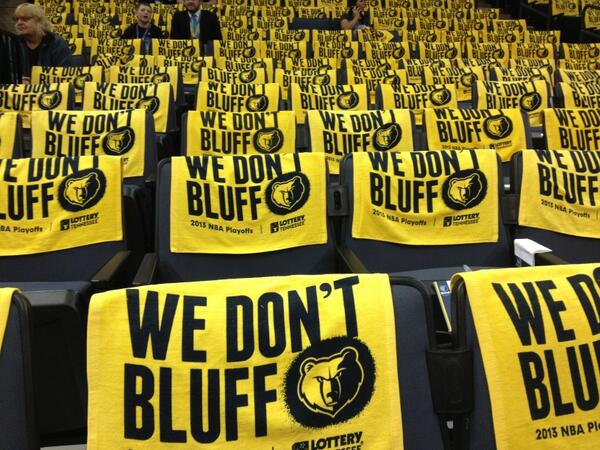
One of those people is Dr. Leigh Johnson, a native Memphian and professor of
philosophy at Rhodes College, a small liberal arts school of about 2,000 students located just a few miles east of downtown proper. As a recent graduate, I am a bit sad to admit that I never had the pleasure of taking one of her classes, but I know a little bit about Dr. J through her writing. She maintains a blog through which she expounds on a wide range of topics, and last night, she took the time to appreciate the Grizzlies' role as a key cog in the resurgence and emotional renaissance in this much maligned city. I've excerpted her post here, but I encourage anyone trying to understand what the Grizzlies' success means to its fans to read it in full (link below).
From Dr. J:
Memphis could always have done a lot of things easier than we did. But we've always elected, voluntarily or otherwise, to do it nice and rough. Why? Quite simply, because if you go down to the [Mississippi] river, you're gonna find some people who live. And real living, for the vast majority of us, is hardly ever nice and easy. There are precious few places in this country where people so deeply and existentially understand that just living is rough-- just getting up every day hoping that it's better than the last, just finding some place to work and to make ends meet, just manufacturing the means to suffer or combat a million both tragic and mundane injustices, just finding a warm (or cool) and safe place to lay your head at night, and just finding some people to eat and laugh and love and dance with while you try to do your best at living. It's something that requires all the heart, grit and grind a person can muster.
Heart, grit and grind don't pay the bills, though, and I'll be the first of the million Memphians to testify to that. [Tina Turner's] "Proud Mary" says that you don't have to worry 'cause you got no money, people on the river are happy to give. But, truth is, Memphis is poor and not a lot of people have a lot to give. Memphis has very real and abiding problems with violence and crime. Memphis is and has always been deeply divided, a microcosm of the very same race and class issues that deeply divide our country as a whole. Memphis fights with itself, which means that it loses every battle it wins, and wins every battle it loses.
My dear friend…once told me that "you can't really say that you love a city until it's given you reason not to." Of course, I know of all the reasons that people say that Memphis is unlovable. And they have no idea the love they're missing out on by not believing in this underdog."
I've always been an unapologetic fan of the underdog… [and] I'm a self-appointed ambassador for Memphis. Locals will tell you, sometimes with gratitude and sometimes with exasperation, that Memphis is a place that won't let you go, keeps bringing you back, whether you want it to or not.
Given the right conditions, which have only just arrived, Memphis has more to give than anyone ever imagined. And I'm even less surprised that, as we say here, ERRYBODY is jumping on board.
Welcome aboard the Memphis bandwagon, y'all. The most soulful, passionate, crazy, infectious, tasty, libidinous, musical, gritty and, to be honest, sexiest wagon around.Full post here: http://readmorewritemorethinkmorebemore.blogspot.com/2013/05/i-bet-you-gonna-find-some-people-who.html
I recognize that the Grizzlies are just a sports team, and if they were not a good team, as they were for a long time, their existence wouldn't mean much to Memphis. That said, their success is a beacon for all of the people in this town, and Dr. J does well to get at that feeling, one that's so palpable this week.
Sunday, March 31, 2013
Media Monitor: How ESPN May Have Unintentionally Exposed Incompetence at UCLA after the Steve Alford hiring
 |
| New UCLA head coach Steve Alford can bring the Bruins back to the highest heights, but how will his style of roundball play in Westwood? (Photo from cdn.breitbart.com) |
From ESPN's Andy Katz, who reported on the UCLA hiring:
"[UCLA athletic director Dan] Guerrero made it clear that he wanted to have a coach who played an exciting style, would help fill the seats at Pauley Pavilion and represented the university and student-athletes well. Alford has a good chance to make all of that happen if he coaches in a similar fashion at UCLA as he did at New Mexico.
'Steve is the perfect fit for UCLA… and brings an up-tempo and team-oriented brand of basketball to Westwood,' Guerrero said."
Glossing over what exactly Katz means by "if [Alford] coaches in a similar fashion at UCLA as he did at New Mexico," Guerrero's statement comes with a very big red-flag that is visible if one merely takes a moment to probe it.
From ESPN LA writer Peter Yoon:
"[Alford is] also a defensive-minded coach who isn’t known for lighting up scoreboards. New Mexico was No. 172 in the nation in scoring this season with 67.4 points per game, so if it’s an entertaining, wide-open style you’re looking for, Alford won’t be bringing it. "Assuming the stat Yoon cites is correct, the scoring numbers of Alford's squad this season rank about halfway down the list of the 347 basketball teams in the NCAA's Division I. That sounds more like middle-of-the-road than leader-of-the-pack. And that's not all.
As pointed out in a Tweet by Yahoo! Sports blogger Jeff Eisenberg that was quoted on BruinsNation.com, the notion of an "up-tempo" offense doesn't jive with New Mexico ranking 239th in the country in possessions per 40 minutes in 2013.
I would not characterize myself as someone who knows a great deal about
 |
| UCLA athletic director Dan Guerrero has some explaining to do. (Photo from Zimbio.com) |
[All of this, of course, makes no judgment on whether or not an "up-tempo" brand of basketball is "an exciting style [that] would help fill the seats at Pauley Pavilion." Winning should bring fans regardless, and if it doesn't, there's a bigger problem afoot in L.A.]
If you Google "steve alford offense," there are a number of prominent search results:
1) A page on MensBasketballHoopScoop.com describes Alford's "2 Out 3 In Motion Offense" as a "unique" system that "allows the post area to become open for isolation plays and opens up dribble penetration and backdoor cut plays." Even I know that nobody gets backdoor-cut into oblivion on a regular basis, especially not in a power conference. (Spoiler alert: How many times has John Thompson III's Princeton-style offense taken Georgetown to the Final Four? Once in nine years? That's what I thought.)
2) ChampionshipProductions.com touts a DVD that features Alford's instructions on a "cutting and screening motion offense." The synopsis of the DVD says that "Benefits of motion offense are shot quality, low turnovers…and getting to the free throw line." The goals of these tactics are said to be "easy baskets, open shots and free throw attempts," all of which sound like the objectives of a conservative team that doesn't shoot particularly well and picks its spots carefully.
3) An analysis of the 2-Out/3-In Offense on CoachPeelBasketball.com notes that "the offense does not lend itself well to the fast break…Teams that employ this offense will want to avoid getting into high-scoring games and instead focus on wearing down the opponent."
The three links above took fairly little time to find, and if you're a Bruin fan, that ought to have you concerned. The evidence is clear, at least at first glance, that Guerrero either failed to research the kind of tactics Alford will use in Westwood, or that he lied about such tactics to the school's fanbase, or that he simply confused them for the tactics of another potential coach that he might have researched in the process. Any way you slice it, Guerrero's apparent inability to grasp Alford's methods (an admission embarrassingly and unwittingly made in print for everyone to see) does not speak well for his capacity to adequately steer a coaching search or evaluate candidates.
I am sure it was not ESPN's intention to make Guerrero look bad, and quite honestly, they didn't. Katz was quoting what had already been said, and Yoon was merely providing a statistic on recent performance, but when the two pieces are juxtaposed, it is very easy to draw a logical conclusion. That's good journalism, I think--though some people believe that journalists have an axe to grind which guides their reporting, this case is proof that more often than not, a public figure only has themselves to blame if they have egg on their face in the news.
Wednesday, March 20, 2013
Real Quick: Rhodes College baseball photos

My feature article on the baseball team came out in the March edition of the school's student newspaper (printed today), and I'll post a few notebook-style observations here that didn't make the final draft of the feature. If you're a baseball fan, you'll be interested in this brief sub-surface look at a D3 team. Enjoy.
Thursday, February 28, 2013
Memphis Grizzlies’ owners: “We have a greater opportunity than ever before”
 If you’re looking for a snapshot of what the Memphis Grizzlies’ future holds, just ask minority-share owner Duncan Williams. He’ll paint you a picture.
“We’re going into [the Grizzlies’] 12th year [in Memphis], and I have a nine-year-old son and 10-year-old daughter,” Williams said on Tuesday. “And I can tell you, they don’t buy any jerseys except Grizzlies jerseys.”
Williams’ anecdote highlights the two-fold impact of Memphis’ only professional sports team in a light-hearted but enlightening way. Since moving east from Vancouver in 2001, the Grizzlies organization has woven itself into the fabric of the Bluff City in a way that outshines traditional standbys like Ole Miss and Tennessee football, and even, in some ways, Memphis Tigers basketball.
“Being a sports fan and a longtime Memphian, I can’t think of any better thing to be involved in,” minority-share owner Edward Dobbs said.
On the court, the franchise has risen from the dregs of the NBA barrel to earn playoff appearances in each of the previous two seasons. Off the court, the organization and its charitable foundation were recognized internationally by Beyond Sport as “Sport Team of the Year” for 2012, a testament to the depth of the team’s commitment to serving its community.

Earning the honor of 'Sport Team of the Year' is not easily done—it took a lot of hard work, and at least one of the Grizzlies new minority-share owners recognized that much of that effort had already been put in before they came on the scene last November.
“We were very fortunate, in coming in as a new ownership group, that we had a team that had a real identity,” Jason Levien said. In addition to having a stake in the team, Levien is also the Grizzlies’ CEO.
“They called it ‘grit and grind’: it’s about winning, selflessness, putting the team first… Our motivation is about winning, about sustained success, about having the kind of players that make this community proud, having the kind of team that makes this community proud, and doing things on and off the court which reflect positively on Memphis. We think we’re headed in that direction, and we feel very excited about it.”
Williams, Dobbs, Levien and former Grizzlies guard Elliot Perry spoke to a lunchtime crowd of a few hundred on Tuesday at the Holiday Inn on Poplar Avenue. The New Memphis Institute, as part of their “Celebrate What’s Right” lecture series, sponsored the luncheon panel of minority-share owners. Grizzlies Charitable Foundation director Jenny Koltnow moderated the discussion, and AutoZone founder Pitt Hyde, another Grizzlies stake-holder, provided the opening remarks.
“We have a greater opportunity than ever before,” Hyde said of the team’s ability to have success and affect change in the city. “It is important to all of us to make sure every seat is filled—it’s important for our image, it’s important to the team to show your support. As business people or people involved in any part of our city, you can always buy tickets, whether you’re a basketball fan or not. Give them to customers, give them to friends, go yourself—I think you’ll find that it’s easy to get addicted to the Grizzlies.”
As Perry pointed out, the addiction is sometimes a two-way street for Grizzlies players.
“What is a little bit unusual about this team is, I played on many teams in the NBA, and the players [on those teams] were not this engaged in the community,” the former University of Memphis star said. “You would have one, maybe two players who realized how to use that platform, but we can go down the list of seven, eight, nine guys who are really engaged in this community.”
That community, by the way, is growing. Levien noted that the team has recently expanded its broadcast radius into Nashville and Little Rock in order to solidify the Grizzlies’ presence as “the team of the Mid-South.” Additionally, the gameday experience at FedExForum is also being improved in a variety of ways to make sure ticket sales can be maintained and (hopefully) increased.
“One thing we really want to do is create a more exciting [game] experience,” Levien said. “Folks come to the game for two-and-a-half hours, and we want to have a better dining experience [for them]. We spend a lot of hours talking about that – what food options there are, what kind of entertainment there is for kids and families that are coming to games. We’re spending time looking at all those things to improve the quality so that we can be an even bigger and better asset for the community.”
As far as progress on the court, Levien and Perry both feel that the Grizzlies have improved their stock through recent trades.
“We feel as though, with the moves we made in the past month, we’ve added substance here,” Levien said. “We got a player in Tayshaun Prince who won an NBA championship [with the Detroit Pistons in 2004]. We got a young player we’re very excited about, Ed Davis, who is a terrific guy to watch because he’s such a great athlete, a young guy who we think is on the way up in his career. He won an NCAA championship at the University of North Carolina [in 2009]. We got a very strong outside shooter, a guy who I think has a lot upside as well, in Austin Daye.”
“I’m very optimistic about the team,” Perry said. “It’s always hard when you trade a guy like Rudy Gay, given that he was such an instrumental part of the team. I think the sky is the limit for him and he really will flourish in Toronto, but ultimately I know that if anything happens here, we have a good enough team [to withstand that adversity].”
Asked about the long-term methods for keeping the team competitive, Levien emphasized the use of advanced statistics to evaluate the team, seizing on a trend which has quickly infiltrated the NBA after being incubated in Major League Baseball over the last two decades. Recently-hired vice president of basketball operations of John Hollinger is someone Levien considers “a founding father of basketball analytics” because of Hollinger's innovative work on hoops statistics while at ESPN, and his presence in the front office, along with new director of player personnel and basketball development Stu Lash, should be a boon to general manager Chris Wallace. Levien also mentioned the creation of a decision-making system which will help guard against the kind of ill-advised, panic-stricken transactions that are too often made right on the heels of a bad loss, a devastating player injury or an ugly statistical report.
Dobbs, one of the latest additions to the minority-share ownership group, said that his initial meeting with Levien was all he needed to hear to be sure the team was on the right track.
“When I first met with Jason, I was really struck by his vision of what the team was going to be, not only from the standpoint of wins and losses, but what the team was going to be in the community and to the fans and people coming to games,” Dobbs said. “When you put all of those things together, it was almost like I couldn’t say no [to having an ownership stake].”
“I’m thrilled to be part of it. It really is a dream come true.”
“We were very fortunate, in coming in as a new ownership group, that we had a team that had a real identity,” Jason Levien said. In addition to having a stake in the team, Levien is also the Grizzlies’ CEO.
“They called it ‘grit and grind’: it’s about winning, selflessness, putting the team first… Our motivation is about winning, about sustained success, about having the kind of players that make this community proud, having the kind of team that makes this community proud, and doing things on and off the court which reflect positively on Memphis. We think we’re headed in that direction, and we feel very excited about it.”
Williams, Dobbs, Levien and former Grizzlies guard Elliot Perry spoke to a lunchtime crowd of a few hundred on Tuesday at the Holiday Inn on Poplar Avenue. The New Memphis Institute, as part of their “Celebrate What’s Right” lecture series, sponsored the luncheon panel of minority-share owners. Grizzlies Charitable Foundation director Jenny Koltnow moderated the discussion, and AutoZone founder Pitt Hyde, another Grizzlies stake-holder, provided the opening remarks.
“We have a greater opportunity than ever before,” Hyde said of the team’s ability to have success and affect change in the city. “It is important to all of us to make sure every seat is filled—it’s important for our image, it’s important to the team to show your support. As business people or people involved in any part of our city, you can always buy tickets, whether you’re a basketball fan or not. Give them to customers, give them to friends, go yourself—I think you’ll find that it’s easy to get addicted to the Grizzlies.”
As Perry pointed out, the addiction is sometimes a two-way street for Grizzlies players.
“What is a little bit unusual about this team is, I played on many teams in the NBA, and the players [on those teams] were not this engaged in the community,” the former University of Memphis star said. “You would have one, maybe two players who realized how to use that platform, but we can go down the list of seven, eight, nine guys who are really engaged in this community.”
That community, by the way, is growing. Levien noted that the team has recently expanded its broadcast radius into Nashville and Little Rock in order to solidify the Grizzlies’ presence as “the team of the Mid-South.” Additionally, the gameday experience at FedExForum is also being improved in a variety of ways to make sure ticket sales can be maintained and (hopefully) increased.
“One thing we really want to do is create a more exciting [game] experience,” Levien said. “Folks come to the game for two-and-a-half hours, and we want to have a better dining experience [for them]. We spend a lot of hours talking about that – what food options there are, what kind of entertainment there is for kids and families that are coming to games. We’re spending time looking at all those things to improve the quality so that we can be an even bigger and better asset for the community.”
As far as progress on the court, Levien and Perry both feel that the Grizzlies have improved their stock through recent trades.
“We feel as though, with the moves we made in the past month, we’ve added substance here,” Levien said. “We got a player in Tayshaun Prince who won an NBA championship [with the Detroit Pistons in 2004]. We got a young player we’re very excited about, Ed Davis, who is a terrific guy to watch because he’s such a great athlete, a young guy who we think is on the way up in his career. He won an NCAA championship at the University of North Carolina [in 2009]. We got a very strong outside shooter, a guy who I think has a lot upside as well, in Austin Daye.”
“I’m very optimistic about the team,” Perry said. “It’s always hard when you trade a guy like Rudy Gay, given that he was such an instrumental part of the team. I think the sky is the limit for him and he really will flourish in Toronto, but ultimately I know that if anything happens here, we have a good enough team [to withstand that adversity].”
Asked about the long-term methods for keeping the team competitive, Levien emphasized the use of advanced statistics to evaluate the team, seizing on a trend which has quickly infiltrated the NBA after being incubated in Major League Baseball over the last two decades. Recently-hired vice president of basketball operations of John Hollinger is someone Levien considers “a founding father of basketball analytics” because of Hollinger's innovative work on hoops statistics while at ESPN, and his presence in the front office, along with new director of player personnel and basketball development Stu Lash, should be a boon to general manager Chris Wallace. Levien also mentioned the creation of a decision-making system which will help guard against the kind of ill-advised, panic-stricken transactions that are too often made right on the heels of a bad loss, a devastating player injury or an ugly statistical report.
Dobbs, one of the latest additions to the minority-share ownership group, said that his initial meeting with Levien was all he needed to hear to be sure the team was on the right track.
“When I first met with Jason, I was really struck by his vision of what the team was going to be, not only from the standpoint of wins and losses, but what the team was going to be in the community and to the fans and people coming to games,” Dobbs said. “When you put all of those things together, it was almost like I couldn’t say no [to having an ownership stake].”
“I’m thrilled to be part of it. It really is a dream come true.”
What are your thoughts on the Grizzlies' prospects this season and in coming years? In what ways have you seen them benefit the Memphis community? Feel free to comment below.
--
[Photo caption: Edward Dobbs, center, a minority-share owner in the Grizzlies, talks about his involvement in the team as part of the New Memphis Institute's "Celebrate What's Right" luncheon at the Holiday Inn on Poplar Avenue.]
Wednesday, February 27, 2013
Mark Emmert, John Feinstein, Harvey Specter, and the future of the NCAA
In a column dated February 20th, Washington Post writer John Feinstein decried the NCAA's shameful inability to police itself while fighting a losing battle against corruption in revenue-earning sports like football and men's basketball. The key points of Feinstein's criticism are well made, and they gave me pause for a moment to consider the lengths to which a wide-reaching governing body has been forced to go in order to maintain control.

Feinstein called the debacle "Keystone Kops vs. Inspector Clouseau." To me, it looks a lot like the plot arc of season 2 of Suits. The frequent assaults on an organization's integrity have made it weak, and some of the people in charge of holding the line feel compelled to use under-the-table tactics to preserve what they have. Julie Roe Lach is go-getter Harvey Specter, and Mark Emmert is law-conscious head honcho Jessica Pearson.
If you're a fan of the show, think about it, and you may find the analogy not so far gone. The rising tide of illegal benefits provided by success-hungry boosters, opportunistic agents and others trying to make a buck off of collegiate athletics has backed the NCAA into a corner from which it can see little daylight.
What is upsetting is not that that one official was willing to sacrifice cash to know the truth (always a bad proposition), but rather that the choice to do so seemed like the most effective one available. We have reached a boiling point beyond which it may be impossible to realistically supervise and appropriately punish all of the schools that commit these violations.
Feinstein asks "What can be done?"
His article provides, directly and indirectly, three potential options for reeling in a system gone haywire. I’ll detail them here and provide a little of my own perspective on his suggestions:
1) Have the NCAA retake control of football conferences, hypothetically beginning with the 2014 football season. The license given to conference commissioners over the terms of the previous two NCAA presidents, Feinstein argues, have allowed control of the college football landscape to pass from its primary governing body to individual leagues. The compacting conference structures have wielded unchecked power over universities eager to find ways to pay for (and thereby continue) their non-revenue sports; however, a freeze on conference structures would give everyone a little more stability in the short term and allow administrators time to thoroughly evaluate what league they would really fit into and why. Feinstein glosses over this option because he probably does not believe it is not viable: the present structure is seems too expansive to overhaul in that way. Here's an excerpt from his column:
2) Consider the Mike Krzyzewski "have/have not" plan, where multiple organizations govern different spheres of college athletics based on whether or not the sport of note makes money (or fails to). Coach K’s idea, as quoted by Feinstein, involves “an organization that does what’s best for college football, one that does what’s best for [men’s] college basketball and one that does what’s best for non-revenue sports.” Given his experience, I tend to respect Krzyzewski’s ideas, though not every coach-recommended idea is a good one (see the recent proposal to accelerate the NBA draft deadline). However, I am curious as to whether having just two organizations, one to oversee basketball/football and one for other collegiate sports, could still be effective.
In thinking that through, I recognize Coach K’s point that “the needs of each are too different for us to keep acting like they’re the same thing;” in light of the fiasco at hand, the bar for properly overseeing football and basketball, to say nothing of 37 other NCAA sports, looks impossibly high. The goal is to be more effective in enforcement, but do you really need to dissolve the entire NCAA to do that? Maybe so—after all, today’s world is one of specialization. But couldn’t there be a revenue-earning division and a non-revenue earning division of one organization? If it were just a two-pronged operation (in terms of enforcement), different sports could have the opportunity to move between the revenue and non-revenue divisions depending on their financial viability (which we can’t truly predict at this juncture). I’m just posing the idea here.
3) Feinstein’s “First, we eliminate all the presidents” plan, whereby each sport gets its own commissioner, “someone who is of the sport and from the sport and familiar with the particular needs and nuances of [it].” Personnel-wise, this makes sense: currently, “seventeen of the 20 members of the NCAA executive council are either college presidents or chancellors,” men who Feinstein characters as “lack[ing] a sophisticated understanding of all of the forces at work in modern athletics.” That said, if “the presidents should be completely removed from the process except (perhaps) to help in fundraising at their schools,” you can see the knee-jerk backlash headline coming from a mile away: “College sports now governed by National Coalition Against Academics,” or some form of wordplay better than my own. It could potentially erode public trust in amateur athletics—yes, beyond its current strained status—and precipitate, in the worst scenario, an ill-advised Congressional intervention (heaven forbid) on behalf of the presidents.
I am not saying that changing the NCAA leadership to a more athletics-oriented set of officials is a bad thing—indeed, it may be the right thing to do. But you can’t knock out all of the presidents without some eyebrows being raised. Keep a few of them, maybe five or eight, just so that there is some semblance. A new executive council in that mold would have to withstand a fair amount of criticism in the early going, but over time it could very well prove to be the right group to legislate and supervise collegiate athletics in the 21st century.
What do you think the NCAA should do? Feel free to comment?
 |
| What do Harvey Specter and Julie Roe Lach have in common? Maybe more than you think. |

Feinstein called the debacle "Keystone Kops vs. Inspector Clouseau." To me, it looks a lot like the plot arc of season 2 of Suits. The frequent assaults on an organization's integrity have made it weak, and some of the people in charge of holding the line feel compelled to use under-the-table tactics to preserve what they have. Julie Roe Lach is go-getter Harvey Specter, and Mark Emmert is law-conscious head honcho Jessica Pearson.
If you're a fan of the show, think about it, and you may find the analogy not so far gone. The rising tide of illegal benefits provided by success-hungry boosters, opportunistic agents and others trying to make a buck off of collegiate athletics has backed the NCAA into a corner from which it can see little daylight.
What is upsetting is not that that one official was willing to sacrifice cash to know the truth (always a bad proposition), but rather that the choice to do so seemed like the most effective one available. We have reached a boiling point beyond which it may be impossible to realistically supervise and appropriately punish all of the schools that commit these violations.
Feinstein asks "What can be done?"
His article provides, directly and indirectly, three potential options for reeling in a system gone haywire. I’ll detail them here and provide a little of my own perspective on his suggestions:
1) Have the NCAA retake control of football conferences, hypothetically beginning with the 2014 football season. The license given to conference commissioners over the terms of the previous two NCAA presidents, Feinstein argues, have allowed control of the college football landscape to pass from its primary governing body to individual leagues. The compacting conference structures have wielded unchecked power over universities eager to find ways to pay for (and thereby continue) their non-revenue sports; however, a freeze on conference structures would give everyone a little more stability in the short term and allow administrators time to thoroughly evaluate what league they would really fit into and why. Feinstein glosses over this option because he probably does not believe it is not viable: the present structure is seems too expansive to overhaul in that way. Here's an excerpt from his column:
“If the NCAA controlled football and if there were rules in place that prevented schools from jumping conferences haphazardly, the current chaos would never have started.
A private organization has a right to make rules. If the members agree to those rules, they must follow them.
If rules existed making it impossible for any school to change conference affiliation without approval from an outside committee, the lawsuits presidents might threaten in order to jump from, say, the ACC to the Big Ten, would be meaningless.”
2) Consider the Mike Krzyzewski "have/have not" plan, where multiple organizations govern different spheres of college athletics based on whether or not the sport of note makes money (or fails to). Coach K’s idea, as quoted by Feinstein, involves “an organization that does what’s best for college football, one that does what’s best for [men’s] college basketball and one that does what’s best for non-revenue sports.” Given his experience, I tend to respect Krzyzewski’s ideas, though not every coach-recommended idea is a good one (see the recent proposal to accelerate the NBA draft deadline). However, I am curious as to whether having just two organizations, one to oversee basketball/football and one for other collegiate sports, could still be effective.
In thinking that through, I recognize Coach K’s point that “the needs of each are too different for us to keep acting like they’re the same thing;” in light of the fiasco at hand, the bar for properly overseeing football and basketball, to say nothing of 37 other NCAA sports, looks impossibly high. The goal is to be more effective in enforcement, but do you really need to dissolve the entire NCAA to do that? Maybe so—after all, today’s world is one of specialization. But couldn’t there be a revenue-earning division and a non-revenue earning division of one organization? If it were just a two-pronged operation (in terms of enforcement), different sports could have the opportunity to move between the revenue and non-revenue divisions depending on their financial viability (which we can’t truly predict at this juncture). I’m just posing the idea here.
3) Feinstein’s “First, we eliminate all the presidents” plan, whereby each sport gets its own commissioner, “someone who is of the sport and from the sport and familiar with the particular needs and nuances of [it].” Personnel-wise, this makes sense: currently, “seventeen of the 20 members of the NCAA executive council are either college presidents or chancellors,” men who Feinstein characters as “lack[ing] a sophisticated understanding of all of the forces at work in modern athletics.” That said, if “the presidents should be completely removed from the process except (perhaps) to help in fundraising at their schools,” you can see the knee-jerk backlash headline coming from a mile away: “College sports now governed by National Coalition Against Academics,” or some form of wordplay better than my own. It could potentially erode public trust in amateur athletics—yes, beyond its current strained status—and precipitate, in the worst scenario, an ill-advised Congressional intervention (heaven forbid) on behalf of the presidents.
I am not saying that changing the NCAA leadership to a more athletics-oriented set of officials is a bad thing—indeed, it may be the right thing to do. But you can’t knock out all of the presidents without some eyebrows being raised. Keep a few of them, maybe five or eight, just so that there is some semblance. A new executive council in that mold would have to withstand a fair amount of criticism in the early going, but over time it could very well prove to be the right group to legislate and supervise collegiate athletics in the 21st century.
What do you think the NCAA should do? Feel free to comment?
Subscribe to:
Posts (Atom)